Green or Black Streaks on the Roof
Those dark stains streaking down your shingles aren't dirt and aren't a sign the roof is worn out — they're living growth, and knowing what kind changes how you handle it.

Green or black streaks on the roof are living growth — usually algae, sometimes moss — not dirt or a worn-out roof. They feed on shade and moisture, which is why they concentrate on north-facing, tree-covered slopes and return after rain. The lasting fix is to reduce the shade and dampness that sustain them; cleaning helps only if the conditions change. Leave roof cleaning and access to a professional — pressure washing shingles does real harm.
The single most useful thing to understand about roof streaks is that you're not looking at a stain. A stain is passive; it stays put and, in theory, washes off. What runs down shaded shingles in dark ribbons is alive — it grows, it spreads, and it comes back after every rain because rinsing a living colony doesn't kill it. Once you accept that the streaks are an organism rather than dirt, the whole problem reorganizes itself: the question isn't "how do I scrub this off," it's "why does this part of my roof stay wet enough to grow things, and what can I change about that."
The two things every colony needs
Growth on any part of a house comes down to the same short list: shade and moisture. Take either one away and the growth struggles. Roofs just happen to offer both in abundance on their darker slopes, and the pattern of streaking usually maps, almost exactly, onto the parts of the roof that get the least sun and dry the slowest. North-facing planes and anything shaded by trees will show it first and worst. When you notice that the streaks stop where the sunlight starts, you've found the whole mechanism.
The moisture side of the equation is often supplied by the trees themselves. Overhanging branches drop leaves and needles that lodge on the shingles and in the valleys, and that damp organic mat holds water against the surface long after the rest of the roof has dried. Debris caught anywhere on the roof does the same. It's the same shade-and-moisture story that drives green growth on siding — the roof is simply the largest, most exposed surface it plays out on.
Not all growth is the same growth
It's worth learning to tell the two main culprits apart, because they call for different levels of concern — and you can do the whole diagnosis from the ground with a pair of binoculars.
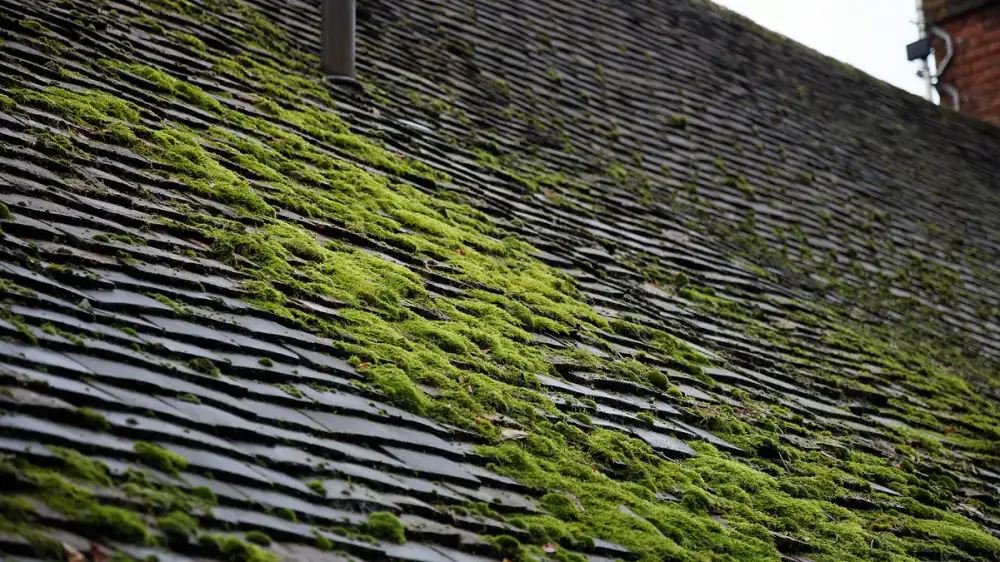
Dark, flat streaks that run vertically down asphalt shingles are almost always a hardy algae. It feeds on the mineral fillers in the shingles and spreads as a thin film; the drip-like pattern comes from spores washing downslope with the rain. This is largely a cosmetic and moisture nuisance. It won't destroy a roof, but it will keep spreading as long as the conditions hold.
Raised, cushiony green tufts that lift at the shingle edges are moss, and moss is the more serious of the two. It behaves like a sponge, holding a reservoir of moisture directly against the shingles, and over time it can work its way under the material and lift it. Where flat algae is mostly an appearance problem, persistent moss growing on the roof is worth treating as something that can actually shorten the life of the roof if left alone.
So the color and texture aren't just cosmetic details — they tell you whether you're managing an eyesore or heading off real damage.
Changing the conditions, not just the appearance
Because the streaks are a symptom of a wet, shaded surface, the durable improvements are the ones that make the roof drier and brighter. Encouragingly, the most effective of these can largely be done without getting on the roof at all.
Cutting back the branches that overhang and shade the roof does two jobs at once: it lets more sun and airflow reach the surface so it dries faster, and it stops the steady rain of leaves and needles that feeds the dampness. If there's a single highest-value move in the whole problem, this is usually it, and much of it can be handled from the ground or from safe, reachable positions.
Keeping the roof and gutters clear of debris removes the damp mat the growth clings to. Clearing gutters from low, stable access also keeps water draining off the edge instead of backing up onto it. These are prevention steps as much as cleanup — you're taking away the moisture the colony depends on.
For treatment itself, the method matters far more than the muscle. Roof growth responds to gentle, low-pressure application of appropriate cleaning solutions, done by someone who can reach the roof safely. And on some homes, metal strips installed near the ridge slowly release trace amounts of metal in rainwater, which discourages regrowth on the slopes below — a genuine prevention measure rather than another round of cleaning. That's a professional installation, but unlike scrubbing, it works on its own once it's up.
The lines you shouldn't cross
Two temptations are worth naming plainly, because both do more harm than the streaks ever would.
The first is the pressure washer. High pressure blasts the protective granules off asphalt shingles — the very layer that gives them their life and their algae resistance — and it can drive water up under the shingles where it has no business being. You can trade a cosmetic problem for a genuine roofing one in an afternoon. Roof growth wants a gentle touch, not force.
The second is getting up there yourself to scrub. A roof is a serious fall hazard on a dry day, and streaked shingles are frequently wet and mossy, which is worse — moss underfoot is slick, and the shingles are easily damaged by boots regardless. Anything that involves standing on the roof, whether it's cleaning, moss removal, or installing ridge strips, is work for a professional with the equipment and footing to do it safely. This is doubly true for moss, which needs careful handling to lift without tearing up the roof beneath it.
A quick word on what not to worry about: streaks by themselves are not a sign the roof is failing or that you need a replacement. They're a report on shade and dampness. And don't wait for rain to solve it — rain only rewets the surface the growth is living on. If you want to see how this connects to the other damp-and-shaded problems that show up around a house, the full list of common exterior problems puts it in context, and a professional can confirm whether persistent growth has begun to affect the shingles themselves.
Common questions
What are the black streaks on my roof?
Those dark streaks on asphalt shingles are almost always a type of algae that feeds on the mineral fillers in the shingles and spreads in a dark, streaky film. It thrives on shaded, moisture-holding roof areas and often appears first on north-facing slopes. It looks like dirt or staining but is living growth, which is why it returns after rain and spreads over time rather than washing away.
Is green growth on the roof different from black streaks?
Often, yes. Green growth tends to be algae or the early stage of moss and appears as a greenish film or tufts, while black streaks are typically a darker algae. Green, cushiony patches that lift at the edges are usually moss, which holds moisture against the shingles and is more aggressive. The color and texture hint at what you're dealing with and how urgently it needs attention.
Do roof streaks mean my roof is failing?
Not by themselves. Algae streaks are primarily a cosmetic and moisture issue and don't mean the roof is worn out. That said, growth that holds moisture against the shingles — especially moss — can shorten their life over time by keeping the surface damp and lifting the material. The streaks are more a sign of shade and dampness than of a roof that's about to fail, but they're worth addressing.
Why do the streaks keep coming back after rain?
Because the growth is alive and the conditions that feed it — shade and moisture — are still there. Rain doesn't remove algae; it simply wets the surface it lives on. As long as the roof stays shaded and slow to dry, the growth persists and spreads, and any streaks you managed to lighten will darken again. Lasting improvement comes from changing the conditions, not from waiting for rain to rinse it.
Can I pressure wash the streaks off my roof?
Pressure washing a roof is generally a bad idea. High pressure strips the protective granules from asphalt shingles and can force water under them, causing more harm than the streaks themselves. Roof growth is better treated with a gentle, low-pressure approach using appropriate cleaning solutions — work that's best done by a professional who can access the roof safely and protect the shingles.
How do I keep the streaks from coming back?
The durable approach is to reduce the shade and moisture that feed the growth. Trimming overhanging branches lets more sun and airflow reach the roof so it dries faster, and keeping the roof and gutters clear of debris removes the damp organic matter growth clings to. Some roofs also benefit from metal strips near the ridge, but any lasting prevention centers on drying and lightening the surface rather than repeated cleaning.
Keep reading

Why Green Growth Keeps Returning on Siding
Algae and mold return because cleaning removes the growth but not the shade and moisture that feed it. Fixing those conditions is what makes it stop.
Moss Growing on the Roof: What to Do
Moss takes hold on shaded, damp roof sections and holds moisture against the shingles — but removing it from the roof is risky work for a professional.

Efflorescence: The White Residue on Brick
The white powder on brick is efflorescence — mineral salts drawn to the surface by moisture moving through the masonry and left behind as water evaporates.