Why Downspouts Keep Clogging
A clean gutter that still overflows usually has a blocked downspout. Here's where downspouts clog, why debris collects there, and how to spot the problem from the ground.
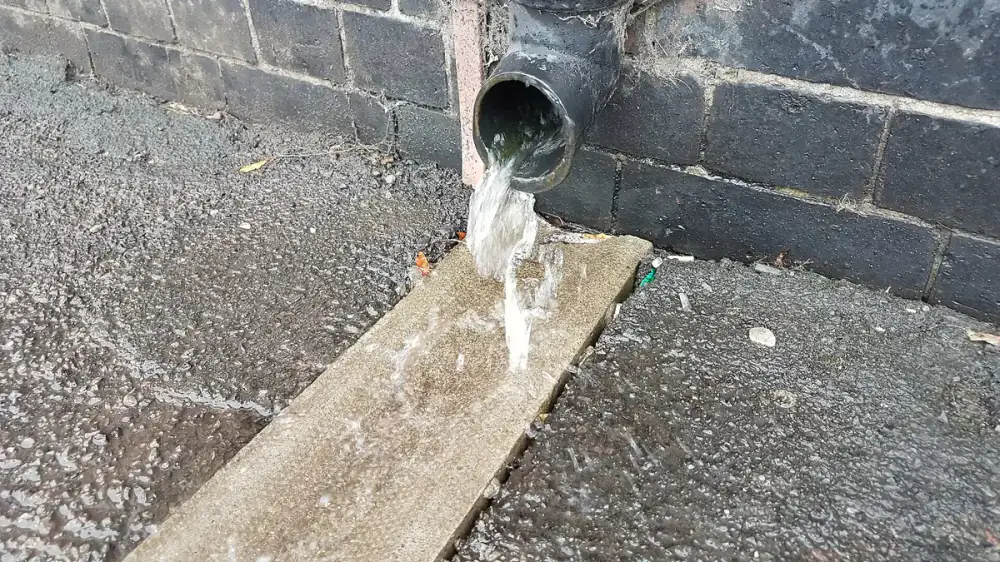
Downspouts keep clogging because debris that travels easily along the open trough gets funneled into a much smaller opening — the top outlet — and then jams again at every elbow and underground bend. Seed pods, pine needles and shingle grit are the usual offenders. The most reliable way to find the blockage is to watch the flow and tap the pipe from the ground during or right after rain.
You scoop the gutters clean, the trough gleams, and the very next storm still throws a curtain of water over the edge. It's a maddeningly common experience, and it almost always means the same thing: the blockage was never in the part you cleaned. The downspout is the narrowest passage in the whole system, and narrow passages are where loose material comes to rest. Learn the handful of spots it stalls and the reasons why, and you can diagnose the problem without ever stepping off solid ground.
The three chokepoints where debris settles
A downspout isn't a single open tube. It's a sequence of pinch points, and each one traps debris for its own reason.
The first and worst is the top outlet, the small opening where the gutter drops into the downspout. Everything the gutter carries, leaves, twigs, seed pods, gets swept toward that one hole, and because it's a fraction of the width of the trough, even a modest handful can bridge across and choke the flow. A drop outlet fitted with a strainer basket clogs here fastest of all.
Next come the elbows. Most downspouts turn at least twice, once up top to tuck against the wall and once at the bottom to send water away from the foundation. Every turn slows the water and hands debris a ledge to settle on. Packed leaves and pine-needle mats collect at these bends, and the clog can be hard to spot because it hides inside the corner of the pipe.
Farthest down are the underground drains and buried extensions that many downspouts feed into. These are the toughest of all. Silt, roots, shingle grit, and washed-in leaves gather where you can't see them, and a full underground line will back water all the way up the downspout until it spills at the top. If the whole vertical pipe checks out clear and it still backs up, the trouble is almost certainly below grade.
What jams the pipe, and why it travels there
Not everything that lands in a gutter ends up plugging the downspout. It helps to know which material does, because the culprits share a telling trait, small enough to move, bulky or dense enough to stall.
- Seed pods and helicopter samaras are dense and rounded. They roll along the trough with ease, then wedge together at the outlet like marbles poured into a funnel.
- Pine needles drop year-round and knit into fibrous mats that pass water but block everything else. Homes near conifers battle this constantly, and our guide on how trees affect gutter maintenance explains why evergreens are such a stubborn source.
- Shingle grit, the sandy granule that sheds off aging asphalt shingles, is heavy enough to drop out of the water at the first bend and slowly build a dam in the elbows and buried lines.
- Blossoms, catkins, and windblown grit arrive in spring, clump the moment they're wet, and settle at the first narrow point they reach.
Telling a downspout clog from a gutter clog
From the yard, both problems look the same, water where it shouldn't be, but they behave differently once you watch closely. A few ground-level checks separate them.
| What you observe | Likely location of the clog |
|---|---|
| Water spills over the trough along much of its length | Gutter trough |
| Trough drains but little or no water exits the downspout bottom | Downspout |
| Water overflows at the top outlet during every rain | Top outlet |
| Water trickles out slowly, long after rain stops | Elbow or partial downspout clog |
| Water backs up and pools at the base or bubbles from the ground | Underground drain line |
The simplest live test is to stand back during a steady rain and take in the whole run. Even overflow along the trough points to the gutter; a trough that drains while the bottom outlet barely dribbles points to the downspout. The pattern of where water escapes is diagnostic in itself, and our article on why water runs behind gutters walks through the other overflow signatures worth recognizing.
When it's dry, add a second test. Work your knuckles or a screwdriver handle down the vertical pipe, tapping as you go. Sections holding water and packed debris answer with a dull, solid thud; empty sections ring hollow. The point where the sound shifts is roughly where the clog sits, often right at an elbow, and it tells you whether the blockage is within easy reach or high up the run. Right after rain, one more check settles it: a hand near the bottom outlet should feel a healthy gush that tapers off. Silence, or a dribble long after the trough should have emptied, with a full gutter above, is an unmistakable downspout blockage.
When a downspout clogs again and again
A downspout that clogs once is routine housekeeping. One that clogs repeatedly is telling you something, and the message is usually hiding in the parts homeowners overlook. The stretch below the last elbow deserves particular suspicion: flip-up and roll-out extensions get left folded, dumping water right back at the foundation and collecting leaves in the crease; corrugated flex pipe snags silt and debris on its ridged inner walls far faster than smooth pipe; and buried lines quietly fill with silt or roots and give no warning until the top overflows.
That pattern also exposes the recurring missteps behind chronic clogs. People clear only the trough and never confirm water actually leaves the bottom. They flush from the top with a hose, which rinses fine silt but drives packed debris deeper and can wedge it tighter in an elbow, so it's better to pull out the bulk first. They swap strainers and elbows over and over while the real blockage sits in the buried pipe downstream. And they lean on gutter guards as if guards made the system self-cleaning, when fine grit and needles still slip through to the pipe.
One misstep is more dangerous than the rest: overreaching from a ladder to poke at a top outlet. That is far riskier than the clog itself, so keep your own work to ground-level checks and hand the height and the buried lines to someone equipped for them. Bring in a professional when the clog sits above comfortable reach, when it's in an underground drain you can't access, when a downspout has pulled loose or cracked at a seam, or when repeated overflow has already done damage, worth catching early against the signs your gutters need repair and, before the cold sets in, a fall gutter and downspout checklist. Left alone, chronic backup is a leading cause of fascia damage from overflowing gutters, which makes diagnosing the real blockage well worth the effort before the water does lasting harm.
Frequently asked questions
Why does my downspout keep clogging even after I clean the gutters?
Because the gutter trough and the downspout are separate chokepoints. Debris that rinses along a clean gutter still piles up where the trough narrows into the top outlet, and it jams again at every elbow. Seed pods, pine needles and shingle grit are small enough to travel but bulky enough to bridge across the opening, so a spotless gutter can still feed a blocked downspout.
How can I tell if the clog is in the gutter or the downspout?
Watch the system during steady rain from the ground. If water spills over the trough along its length, the gutter is likely blocked. If the trough drains but little or nothing comes out the bottom of the downspout, the clog is in the downspout. You can also tap the vertical pipe from top to bottom: a dull, solid thud marks the debris line, while an empty section rings hollow.
What is the most common place for a downspout to clog?
The top outlet, where the gutter drops into the downspout, is the usual culprit because the opening is small and every bit of debris in the run gets funneled to it. The elbows are the next most common spot, since the change of direction slows water and lets material settle. Underground drain lines and buried extensions clog farther down and are the hardest to clear.
Can a clogged downspout damage my house?
Yes. When a downspout backs up, the gutter overflows and dumps water against the fascia, soffits and foundation — exactly what the system is meant to prevent. Over time that leads to fascia rot, staining, basement seepage and soil erosion near the foundation. A blockage that freezes in winter adds weight that can pull the downspout loose.
Should I remove my downspout to clear a stubborn clog?
Sometimes, but do it from the ground and only if you can reach the fasteners safely. A short section of downspout can often be unhooked, tapped clear and reattached without a ladder. Blockages high on the run, in underground drains, or anywhere that requires height are better left to a professional with the right tools.
Do gutter guards stop downspouts from clogging?
They help but do not eliminate the problem. Guards keep leaves and larger debris out of the trough, which reduces what reaches the outlet, but fine grit, shingle granules and pine needles still wash through and can settle in elbows and underground drains. Guarded systems still need periodic checks.
When should I call a professional for a clogged downspout?
Call one when the clog is above comfortable ground reach, when it sits in an underground drain line, when a downspout has pulled loose or is damaged, or when repeated overflow has already caused fascia, soffit or foundation issues. Any work that means climbing to height or clearing a buried pipe is best handled by a pro.
Related reading

How Trees Affect Gutter Maintenance
Leaves, pine needles, seed pods and shade each create a different gutter problem. Here's how tree cover reshapes your maintenance schedule.
Why Water Runs Behind Gutters
A missing drip edge, a gutter hung too low, or an overflowing clog — these three causes explain most water that ends up behind the gutter.
Signs Gutters Need Repair Instead of Cleaning
Sagging runs, leaking seams, loose hangers and standing water are repair problems, not cleaning problems. Here's how to tell them apart.