Moss Grows on Only One Side of the Roof
Moss that colonizes one roof slope and skips the other isn't picky by accident — it's drawing you a map of where your roof stays shaded and damp.
Moss favors one roof slope because only that side stays shaded and damp long enough for it to establish — usually the slope facing away from the sun or the one under tree cover. The other side dries fast and gets sun, so moss never takes hold. The moss is mapping where your roof stays wet. Treat it gently (never pressure-wash a roof), address the shade and debris feeding it, and leave the roof-surface work to a professional.
It's one of the stranger things a house can show you: one slope of the roof is clean, and the other wears a thick green coat, as though two different roofs were bolted onto the same building. It looks like luck of the draw. It's the opposite. Moss is among the pickiest tenants your house has, and the fact that it settled on one slope and flatly refused the other is a precise readout of the conditions each side offers. Learn to read it, and the divided roof turns into a moisture map you didn't have to pay for.
The tenant that only rents in the shade
Moss doesn't sprawl across whatever surface catches its spores. It needs a specific lease: cool temperatures, shade, and moisture that sticks around long enough for it to root and thicken. Where a surface runs warm, sunny, and dries quickly, moss can't get a grip no matter how many spores drift onto it. So when it takes one slope and skips its neighbor, it isn't choosing sides — it's simply growing in the only place that will have it.
That's what makes the split so informative. The green slope is the one that stays cool and damp. The clean slope is the one that warms and dries. Every other clue about your roof follows from that single difference.
Reading the difference between the slopes
Which way it faces
The largest factor is usually aspect — the direction the slope faces. The side that turns away from the sun's daily path (across most of the country, the north-facing slope) collects far less direct light. It runs cooler, holds moisture longer after rain, and never gets the warming, drying exposure the sunny side enjoys. That's the textbook recipe for one-sided moss, and it's why the shaded slope is so reliably the green one.
What hangs over it
Trees rewrite the equation. A slope shaded by overhanging branches loses its sun even where it would otherwise catch some, so it stays damp. On top of that, trees shed leaves and debris that settle on the shingles, hold water against the surface, and feed the growth directly. A slope tucked under branches gets both at once — persistent shade and a steady supply of dampness-holding litter, a combination moss thrives in. It's the same dynamic that keeps green growth returning on shaded siding, just relocated to the roof.
What sits around and below it
Anything else that keeps a slope from drying pitches in: a neighboring structure that blocks the sun, a lower roof stuck in the shadow of an upper one, or debris caught along the edge and in the gutters that keeps the bottom courses of shingle wet. A slope whose gutters clog and hold water — a relative of overflow concentrated at one corner — stays wetter along its lower edge, which is exactly where moss tends to start.
Moss, algae, or lichen — a quick field guide
It's worth knowing what's actually growing up there, because the three usual suspects behave differently:
- Moss is the thick, cushiony green growth that stands up off the surface and can lift shingle edges. It holds the most water and does the most to keep a roof damp.
- Algae shows up as flatter green or black streaks and film — the same organism behind black streaks on many roofs — and is more of a staining nuisance than a lifting one.
- Lichen is the crustier, often gray-green growth that grips tightly and roots into the shingle. It's stubborn and can be harder on the surface it's attached to.
All three favor shade and moisture, so the one-sided pattern and its underlying causes are much the same across them. What changes is how aggressively each holds water and disturbs the surface beneath.
When the wet slope becomes more than cosmetic
Light, new moss is mostly an appearance issue. The concern rises with the moss. As it thickens, it presses a layer of moisture against the roof and can work under the edges of shingles, lifting them slightly. Lifted shingles and trapped dampness are precisely the conditions that wear on a roof over time — keeping the surface beneath from drying and, when the temperature drops, giving water a place to sit and freeze. So an established, thickening mat isn't just a green nuisance; it's a sign that one slope is staying persistently wet, and that's worth taking seriously.
Judging it without leaving the ground
You don't need to be on the roof to work out what's feeding the moss — and in winter or on a mossy slope, you genuinely shouldn't be. From the ground and from upstairs windows you can gather the whole picture:
- Note which slope carries it. A shaded, sun-averse, or tree-covered side confirms shade and slow drying as the drivers.
- Look at what's overhead. Overhanging branches, a taller structure, or dense cover on that side explains the persistent shade.
- Check the edge and gutters below the mossy slope. Debris-packed gutters holding water keep the lower shingles damp and feed the growth from the bottom up.
- Compare drying times. Watch how long that slope stays wet or frosted after sunrise next to the clean side; the slow-drying one is the mossy one for a reason.
- Gauge the thickness. A faint tint is cosmetic; a raised mat that's lifting shingle edges is established growth worth acting on.
The aim is to understand why that slope stays wet, because that's the thing you'll want to change — not to climb up and prod at it.
Two jobs: the treatment and the conditions
There are really two tasks here, and they belong to different people. One is treating the moss correctly. The other is changing the conditions so it doesn't simply march back.
The treatment is not a ground-level job, and the method is unforgiving. Roofs should be cleaned gently — appropriate solutions and low pressure, never a pressure washer, which strips shingle granules and drives water up under the courses. The work also puts you at height on a wet, moss-slicked surface, which is treacherous underfoot. This is squarely professional territory, both for your safety and to keep a cosmetic problem from becoming a structural one. Scraping or scrubbing established moss off the shingles yourself tends to tear up the surface along with the growth, and climbing a moss-covered slope to do it is the kind of risk that isn't worth taking.
The conditions, by contrast, are largely yours to influence from the ground. Trim the overhanging branches so light and air finally reach that slope and it can dry. Keep the area clear of the debris that holds moisture. Make sure the gutters below aren't holding water against the lower edge. Change what keeps the slope damp and you change how fast the moss returns — because if the shade and moisture remain, removal alone just puts you on a permanent cleaning cycle. The one thing not to shrug off is thick moss that's visibly lifting shingles; that's the point where the dampness underneath starts to matter.
Because roof work combines height, a slippery surface, and a cleaning method that damages shingles when it's done wrong, the removal is worth handing to a professional — especially once the moss has thickened enough to lift shingle edges, so the roof can be checked for whether the persistent dampness has begun to affect it. A pro can also point out which overhead conditions are most worth changing to keep that slope drier.
One-sided roof moss looks like bad luck, but it's really good information. It has shown you exactly which slope stays cool, shaded, and slow to dry — and once you know that, you know both why the moss is there and what would keep it from coming back. Handle the roof itself carefully, change the conditions you can reach, and the green side stops being a permanent feature. For how this connects to the other growth and moisture issues around a house, the full list of common exterior problems is a useful next stop.
Questions people also ask
Why does moss grow on only one side of my roof?
Because only one side gives moss what it needs: shade and lingering moisture. Moss struggles in sun and dries out where a surface gets warm and airy, so the slope that faces away from the sun — often the north side — or the one shaded by trees stays cool and damp long enough for moss to take hold. The other slope dries quickly after rain and gets more direct sun, so moss never gets established there. The one-sided pattern is really a map of where your roof stays wet.
Is moss on the roof actually damaging?
It can be, over time. Moss holds moisture against the roof surface and can work its way under the edges of shingles, lifting them and keeping the area beneath persistently damp. That trapped moisture is the real concern, more than the appearance. A light, new growth is mostly cosmetic, but established moss that's thickening and lifting shingle edges is worth addressing before it affects the roof's ability to shed water.
Can I just pressure-wash the moss off?
Pressure washing a roof is a bad idea. The force can strip the protective granules off shingles, drive water up under them, and damage the surface — often causing more harm than the moss did. Roofs are meant to be treated gently, typically with an appropriate cleaning solution and low pressure, and the work itself involves height and a slippery surface. This is a case where the removal method matters as much as the removal, and it's usually best left to a professional.
How do trees contribute to roof moss?
In two ways. They cast shade that keeps a slope from drying and getting sun, which is exactly the condition moss needs, and they drop leaves and debris that hold dampness against the roof and feed the growth. A slope tucked under overhanging branches gets a double dose — persistent shade plus a steady supply of moisture-holding debris — which is why moss so often concentrates on the tree-covered side.
Will the moss come back after it's removed?
If the shade and moisture that fed it are still there, yes — moss will recolonize the same slope, because the conditions that favored it haven't changed. Lasting control comes from addressing those conditions where you can: trimming overhanging branches to let in light and air, keeping the roof and gutters clear of moisture-holding debris, and improving how quickly that slope dries. Removal alone buys time; changing the conditions is what stretches the interval.
Is one-sided moss a sign my roof is failing?
Not by itself. One-sided moss is primarily a sign of shade and moisture on that slope, not of a failing roof. That said, moss that has thickened and started lifting shingle edges is worth a closer look, because persistent dampness under lifted shingles is the kind of condition that can shorten a roof's life. Treat established moss as a prompt to check the roof's condition, not as proof it's failing.
Related guides
Why Green Growth Keeps Returning on Siding
Algae and mold return because cleaning removes the growth but not the shade and moisture that feed it. Fixing those conditions is what makes it stop.
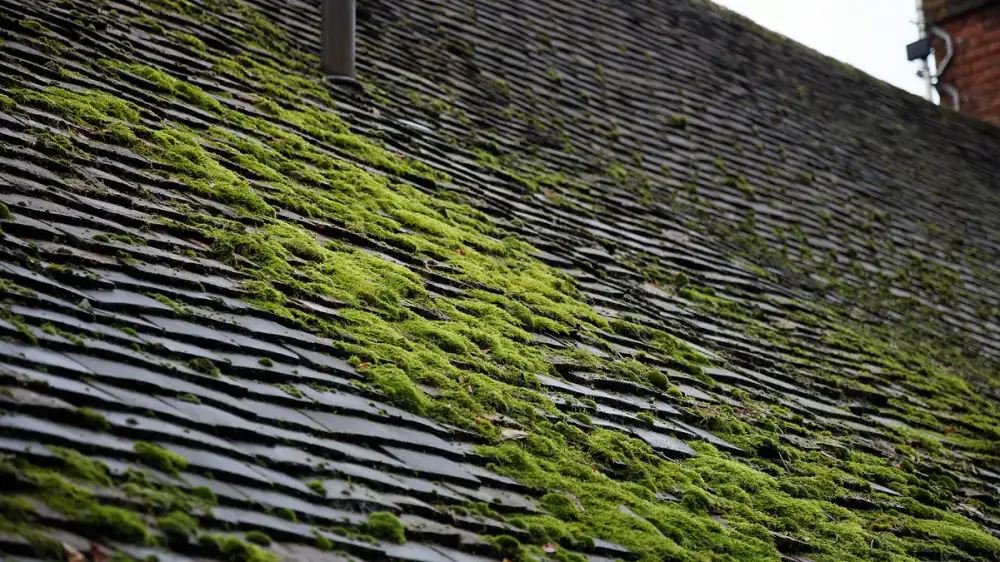
Moss Growing on the Roof: What to Do
Moss takes hold on shaded, damp roof sections and holds moisture against the shingles — but removing it from the roof is risky work for a professional.

Efflorescence: The White Residue on Brick
The white powder on brick is efflorescence — mineral salts drawn to the surface by moisture moving through the masonry and left behind as water evaporates.