A Gutter That Overflows at Just One Corner
When a whole run of gutter stays put but water pours over one corner every storm, that single spot is doing you a favor — it's pointing straight at the problem.

A gutter that overflows at one consistent corner is marking the low point where water collects because it can't drain fast enough. The usual causes are a blocked or undersized outlet at that corner, a section that sagged and lost its slope, a leaking miter joint, or a roof valley dumping a concentrated stream right there. Clear the outlet first — often that's the whole fix — then look at slope and the roof above. Leave re-pitching and roof-edge work to a pro.
Most gutter troubles are maddeningly vague. Water ends up everywhere, nothing points anywhere, and you are left guessing which of a dozen things went wrong. A gutter that overflows at exactly one corner, every storm, is the rare exception — a complaint that comes with its own diagnosis attached. That corner is not spilling by chance, and it is not spilling in a different place each time. The stubborn consistency of the spot is the single most useful piece of information the house will ever hand you, because it tells you the fault sits in one fixed location and stays there.
The corner is the message
Water is relentlessly literal: it finds the lowest available point and pools there. In a gutter behaving as it should, water runs down the slight built-in pitch of the trough, reaches the downspout outlet, and leaves. Interrupt that flow anywhere and the water backs up, rising until it finds the lowest lip it can spill over. Because a blockage or a sag does not wander, the spilling happens in the same place storm after storm. The rest of the run looks fine not because everything upstream is perfect, but because one corner is quietly absorbing the entire failure on its behalf.
That is why it pays to treat the corner as a pointer rather than a nuisance. It is aimed directly at whatever is keeping water from reaching the downspout.
Four things that pin water to one spot
There are really only four culprits behind single-corner overflow, and they leave different fingerprints. This is how they sort out:
| What you notice | Most likely cause | What it actually is |
|---|---|---|
| Gutter spills but the downspout below only trickles | Blocked or restricted outlet | Debris choking the drain opening |
| A pool sits in the trough after the rain stops | Lost slope from a sag | A hanger or section has dropped |
| Water seeps from the joint itself, not over the lip | Failed miter | A corner seam has opened up |
| Overflow only in heavy rain, right under a roof valley | Concentration from above | More water arriving than the stretch can carry |
A blocked outlet is the most common by a wide margin, and the reason is simple: the outlet is where an entire run drains, so a wad of leaves, grit, or shingle granules packed around it chokes everything. In light rain the water still slips through and all seems well; in a real storm the trough fills faster than the throttled opening can empty, and it spills at the nearest low lip. Check this first, and often you can stop there.
A sag works differently. Gutters need a gentle, continuous fall toward the downspout, and when a stretch drops — from a failed hanger, the accumulated weight of old debris, or simple age — water pools in the low belly instead of running on. That standing water is both symptom and setup: it lingers after the storm and overflows during the next one. A failed miter is easy to mistake for overflow, since corners are where two sections meet and seals fail, but the fix is a resealed joint, not a cleared drain, so it is worth distinguishing. And a roof valley is the one cause that has nothing to do with the gutter's condition: where two roof planes meet, they funnel a concentrated stream to one point at the eave, and if that point sits above your corner, a perfectly clean, well-pitched gutter can still be overwhelmed. That is a capacity problem, close kin to the ones behind gutters that overflow only in heavy rain.
Sorting them out from the ground
You can settle most of this without leaving the lawn, and one well-timed look during a storm does the heavy lifting. Stand where you can see both the overflowing corner and the downspout beneath it. If water gushes steadily from the bottom of the downspout while the trough above still spills, the outlet is throttled. If the downspout barely trickles as the gutter pours over, the same conclusion follows even more strongly. Watch whether water tips over the corner's lip, which points to flow or capacity, or seeps from the miter seam itself, which points to a failed seal. After the rain, look for a lingering pool at the corner — a reliable sign of lost slope or a plugged outlet. Then trace the roof above: a valley or a long plane feeding that exact spot suggests the water is simply being concentrated there. Finally, read the ground below for splashback, eroded mulch, or a wet patch that confirms where the overflow keeps landing. The aim is to separate a blockage from a slope issue from a capacity issue, because each sends you toward a different fix.
Why one corner earns more worry, not less
It is tempting to shrug off overflow that stays politely confined to a single spot. Resist that. Concentrating all the escaping water in one place is arguably harder on the house than spreading it thin, because the same section of fascia, the same stretch of siding, and the same patch of soil take the soaking storm after storm. That relentless, focused wetting is exactly what leads to dark stains on the soffits and to damp fascia that eventually invites fascia rot at that corner. Down at grade, the concentrated discharge is a dependable route to water pooling near the foundation in one telltale spot. A single overflowing corner is a small problem only until it has repeated itself a few dozen times.
What you can handle, and where to stop
The most productive first move is clearing the outlet. If that corner sits on a low, single-story section you can reach safely from the ground or a stable footing, pulling debris from around the downspout opening restores flow, and for a great many homes that ends the whole affair. Confirm the downspout itself is open and carrying water clear of the wall — a working extension keeps the concentrated discharge from doing damage below.
Past clearing, the work climbs both in difficulty and in height, and this is where honesty about limits matters. Re-pitching a sagging run, tightening or replacing hangers, and resealing a leaking miter all mean working at the gutter line, and a roof valley overwhelming a corner is a capacity and roof-edge question. A common way to waste an afternoon here is smearing fresh sealant over a wet, grimy miter — it will not bond and it will fail fast, a textbook case of a repair that doesn't hold. Gutter-line work carries a real fall risk, so re-pitching, resealing, and anything requiring a ladder on uneven ground are worth handing to a professional who can correct the slope, seal the joint properly, or add capacity where the roof demands it — and check whether the repeated soaking has already started on the fascia or soffit.
The quiet good news in all of this is that a single overflowing corner has already done the hardest part of the diagnosis for you. Follow the water to the spot, decide whether it is a blockage, a sag, a seal, or the roof above, and you get to fix the actual problem instead of chasing water around the whole house. For the wider picture of how drainage troubles connect, the full list of common exterior problems is worth browsing.
Answers to common questions
Why does my gutter overflow at only one corner?
Because that corner is the low point where water collects when something upstream isn't letting it drain. Water always seeks the lowest spot, so if an outlet is blocked, a section has lost its slope, or a roof valley is concentrating runoff there, the trough fills and spills over at that one corner first. The consistency of the location is the clue — it means the restriction is fixed in one place, not spread across the whole run.
Does one-corner overflow mean the gutter is clogged there?
A clog at or near that corner's outlet is the single most common cause, so it's the first thing to check. But it's not the only possibility. A section that has sagged and lost its slope will pool at the low corner, a leaking miter joint can look like overflow, and a roof valley dumping a concentrated stream at that corner can overwhelm it even when it's clean. Clear it first, then look further if the overflow continues.
Can a roof valley cause overflow at one spot?
Yes. A valley is where two roof planes meet, and it funnels a large, concentrated volume of water to one point at the roof edge. If that point is right above the overflowing corner, the gutter there may simply be receiving more water than that stretch can handle in a downpour, even when it's clear and sloped. Overflow that lines up directly under a valley and shows up mainly in heavy rain points to this.
Why does water pool at that corner after the rain stops?
Standing water left in the gutter after a storm is a strong sign that section has lost its slope or the outlet isn't draining. A properly pitched, clear gutter empties out; one that holds a pool at a corner is telling you water can't get to or through the downspout there. That lingering water is also what feeds overflow the next time it rains hard.
Is corner overflow worse than overflow along the whole run?
It's not necessarily worse, but it is more concentrated, which changes the damage. All the escaping water lands in one spot storm after storm — soaking one section of fascia, one stretch of siding, and one patch of ground by the foundation. That repeated, focused wetting is why one-corner overflow so often shows up alongside localized staining, damp trim, and pooling right below it.
Can I fix one-corner overflow myself?
Clearing debris from an outlet on a low, safely reachable section is reasonable ground-adjacent work, and for many homes a blocked outlet is the whole problem. What's beyond DIY is re-pitching a sagging run, resealing a leaking miter, or addressing a roof valley overwhelming the gutter — those involve height, slope adjustment, or roof-edge work that's better left to a professional.
More from this section

Why Green Growth Keeps Returning on Siding
Algae and mold return because cleaning removes the growth but not the shade and moisture that feed it. Fixing those conditions is what makes it stop.
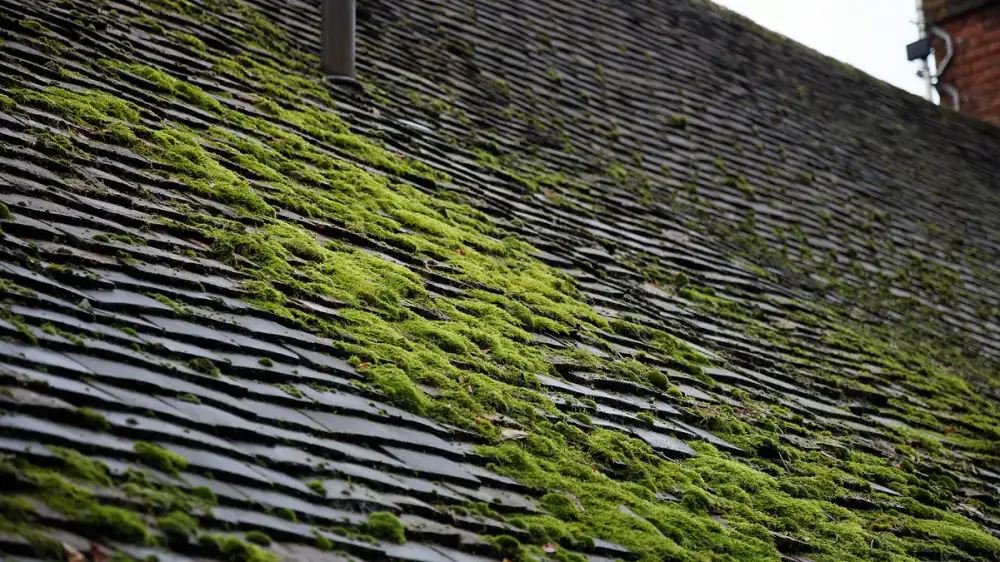
Moss Growing on the Roof: What to Do
Moss takes hold on shaded, damp roof sections and holds moisture against the shingles — but removing it from the roof is risky work for a professional.

Efflorescence: The White Residue on Brick
The white powder on brick is efflorescence — mineral salts drawn to the surface by moisture moving through the masonry and left behind as water evaporates.