Why Your Last Exterior Repair Didn't Hold
If a repair you made comes undone in a season or two, the fix usually wasn't wrong so much as aimed at the wrong thing — the symptom instead of what caused it.

An exterior repair usually fails not because it was done badly but because it was aimed at the symptom instead of the cause. If the water source, movement, or condition that created the problem is still active, it goes right back to work on your new repair. The other common culprits are skipped prep, the wrong conditions or timing, and fighting water instead of redirecting it. A fix holds only when you've changed the thing that caused the damage — not just erased the mark it left.
There's a specific flavor of discouragement in redoing a repair you were certain you'd finished. You patched it, sealed it, painted it, or refastened it, stepped back satisfied — and a season or two later there it is again, as though you'd never lifted a finger. The reflex is to blame the caulk, the paint, the weather, or your own hands. But most failed exterior repairs aren't done poorly. They're done to the wrong thing. The workmanship was fine; the aim was off. And once the handful of patterns behind undone repairs become visible, they stop catching you.
The mistake underneath most of the others
Nearly every failed repair traces back to one confusion: treating the visible damage as the problem when it was only the evidence of the problem. A stain, a peeling board, a loose panel, a hairline crack — these are what a cause leaves behind, not the cause itself. Erase the mark but leave the cause running, and the cause simply produces the same mark again, this time on your fresh repair.
The pattern repeats everywhere. Green growth returns on siding no matter how often it's washed, because the shade and moisture feeding it never changed. Paint peels off a freshly painted board because the wood is still getting wet from behind. A resealed gutter corner spills again because the outlet above it is still choked. In each case the repair was competent and the failure was guaranteed, because the work never touched the reason the damage happened. That's the master key to this entire subject: a repair holds only when it changes the condition that caused the damage.
Three quieter ways good work comes undone
Symptom-chasing is the headline failure, but a few others account for most of the rest — and they're sneakier, because the repair often looks flawless right up until it doesn't.
Prep that was skipped or rushed
An enormous share of repairs fail not at the repair but at the surface beneath it. Genuinely good materials can't bond to a surface that wasn't ready for them. Paint over a dirty, glossy, or damp board won't grip. Fresh caulk smeared over old cracked caulk has nothing sound to hold, and it splits along the same line. A patch laid on a surface that wasn't cleaned and dried lifts at its edges. The product almost never fails — the bond does. Prep is unglamorous and easy to shortcut, which is exactly why it's such a dependable cause of repairs that look great for a month and then let go.
Timing and conditions that were wrong
Many exterior materials need the right circumstances to cure and bond: a dry surface, workable temperatures, and time before rain or a freeze arrives. Sealant applied to a damp surface never fully bonds. Paint that didn't get to cure before a storm can fail even when the prep was immaculate. A repair rushed into the wrong weather is fighting the material's own chemistry, and the chemistry tends to win. It's the reason a fix can look perfect the afternoon you finish and come apart the first time the weather leans on it.
A repair that fought water instead of moving it
Water is patient and relentless, and repairs that try to block it where it collects usually lose. Seal a crack where water pools against a foundation and the water just finds the next weak point. Coat the inside of a wall that's wet from outside and you trap the moisture rather than stopping it. The repairs that hold don't try to out-stubborn the water — they lead it away. Extending a downspout so runoff never reaches the wall, correcting a grade so water drains off, restoring a gutter so it carries water clear: these win because they remove the water from the equation instead of standing in its path. Any repair built to hold water back rather than lead it away is living on borrowed time.
When you aimed one step short
There's a subtler cousin of symptom-chasing worth naming on its own, because it can fool careful people. Sometimes the repair targeted something real — just not the thing actually driving the damage. A downspout that froze and split gets its cracked section replaced, but the clog that trapped the water inside is still there, so the next hard freeze splits the new pipe too. A stain gets painted over while the leak feeding it keeps working behind the fresh coat. The work addressed a genuine problem; it simply stopped one link upstream of the real one. This is the hardest failure to catch, because it looks like you went after the cause when you actually pulled up just short of it.
A short diagnostic you can run from the ground
Working out which trap caught you is mostly a matter of asking honest questions, and every one of them can be answered without leaving the yard:
- What would happen if I did nothing more? If the original condition — the overflow, the wet wall, the movement — is still present, you fixed a symptom.
- Can I name the exact condition I changed so it can't recur? If yes, you addressed the cause. If you can't point to it, you probably didn't.
- Was the surface truly clean, sound, and dry when I made the repair? If not, prep is a prime suspect.
- Did the repair get the right conditions and enough time to set before weather hit it? If rain or frost came too soon, timing may have doomed it.
- Am I blocking water or redirecting it? Blocking tends to fail; redirecting tends to hold.
- Has this exact repair failed before? Repeat failure is the loudest possible signal that the real cause is still untouched.
The point isn't to blame your past self. It's to find what the repair missed, because that missing piece is what the next attempt has to hit.
Doing it in the order that lasts
Everything above resolves into a single discipline, and it's mostly about sequence. Before you fix anything, understand why it broke — trace the water, the movement, or the condition to its source. Deal with that source first: correct the drainage, carry the water off with a proper downspout extension, fix the grade that's steering runoff toward the house the way water pooling near the foundation demands, or resolve whatever was driving the damage. Then prepare the surface properly — clean, sound, dry. Then make the repair, in the right conditions, with time to set. Done in that order, the fix has a real chance, because you've removed the force that would otherwise undo it.
It's slower than reaching straight for the caulk gun. It's also the difference between fixing something once and fixing it every single year. Which is why the temptations worth resisting are the obvious ones: don't repeat the repair that already failed, don't shortcut the prep, don't work in damp or fast-changing weather because it's convenient, and don't try to dam water where it collects when redirecting it is what actually works.
The signal that it's out of your hands
The clearest cue to stop and call someone is repetition. When the same repair fails a second time, the cause is beyond what a surface fix can reach — and often beyond what's safe or practical to chase yourself. Bring in a professional when the source sits at the roof edge or high up, when you can't identify why the damage keeps recurring, or when a repair keeps coming undone despite careful work. This is also the moment to be honest about heights: a repair that's failed more than once and lives up a ladder or on the roof is precisely the combination — recurring failure plus fall risk — that belongs with someone equipped for it. A pro can find the underlying cause and fix that, so the repair finally has nothing left working against it.
A repair that didn't hold isn't a verdict on your ability. It's information. It's telling you the cause is still in the room, and that the next fix needs to aim further upstream. Aim there, prep well, and let the water go somewhere useful, and you'll find most exterior repairs are perfectly capable of lasting. For the wider view of how these problems connect, the full list of common exterior problems is the place to keep reading.
Frequently asked questions
Why do my exterior repairs keep failing?
Usually because the repair addressed the visible symptom without fixing what caused it. If you patch a stain, reseal a joint, or repaint a board while the water or condition that damaged it is still active, the same force goes right back to work on your new repair. A fix only holds when it's aimed at the cause — the drainage, the moisture source, the movement — not just at the mark the cause left behind. Repeated failure is the clearest sign the real problem is still in place.
How do I know if I fixed the symptom or the cause?
Ask what would happen if you did nothing more. If the same conditions that created the problem are still present — the gutter still overflows, the wall still gets wet, the soil still slopes toward the house — then you fixed a symptom and it will return. If you can point to the specific condition you changed so it can't recur, you addressed the cause. A good test is whether you understand why the damage happened in the first place; if you don't, you probably treated the symptom.
Does prep really matter that much for exterior repairs?
Enormously. A large share of failed repairs fail at the prep stage, not the repair stage. Paint applied over a dirty, glossy, or damp surface, caulk smeared over old cracked caulk, or a patch laid onto a surface that wasn't cleaned and dried simply can't bond, no matter how good the product is. The materials are rarely the problem; the surface they were asked to stick to usually is. Skipping prep is the quiet reason many careful-looking repairs come undone.
Why did my repair fail so fast after looking fine at first?
Because many repairs look successful until the condition that caused the problem cycles back — the next heavy rain, the next freeze, the next hot day. A repair done over an active water source or without room for the material to move can appear perfect for weeks and then fail the moment the weather tests it. Looking fine at first isn't the same as holding; the real test is the season, not the afternoon you finished.
Can weather or timing cause a repair to fail?
Yes. Many exterior materials need the right conditions to cure or bond — a surface that's dry, temperatures in a workable range, and time before rain or freezing arrives. A sealant applied to a damp surface, or paint that didn't get to cure before a storm, can fail even when everything else was done right. Rushing a repair into the wrong conditions is a common and avoidable reason it doesn't hold.
When should I stop repairing and call a professional?
When the same repair fails more than once, that's the signal the real cause is beyond what a surface fix can reach — and often beyond what's safe or practical to diagnose yourself. Recurring failure, problems whose source is at the roof edge or up high, and any repair that keeps coming undone despite good technique are all good reasons to bring in a professional who can find the underlying cause and address it properly.
Keep reading

Why Green Growth Keeps Returning on Siding
Algae and mold return because cleaning removes the growth but not the shade and moisture that feed it. Fixing those conditions is what makes it stop.
Moss Growing on the Roof: What to Do
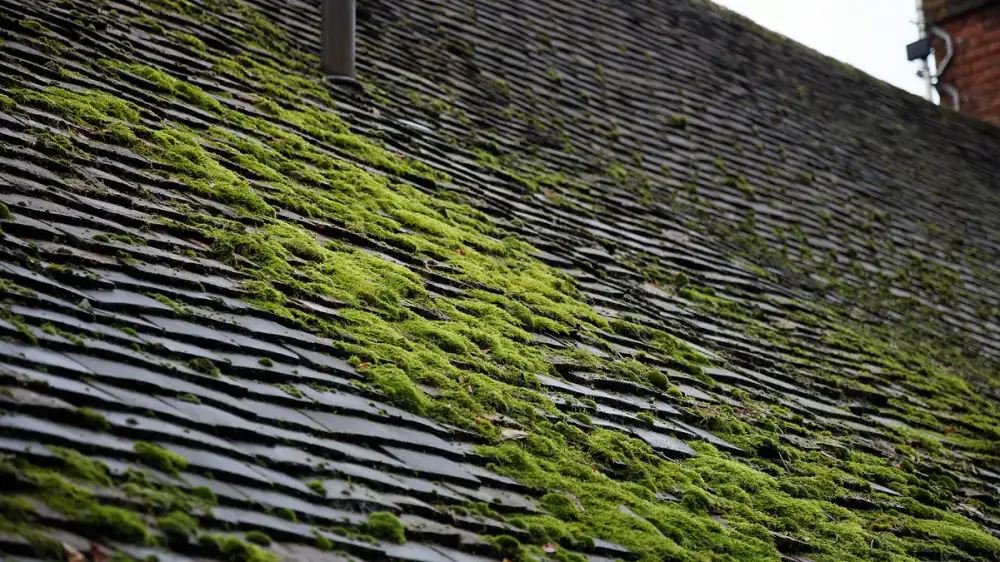
Moss takes hold on shaded, damp roof sections and holds moisture against the shingles — but removing it from the roof is risky work for a professional.

Efflorescence: The White Residue on Brick
The white powder on brick is efflorescence — mineral salts drawn to the surface by moisture moving through the masonry and left behind as water evaporates.