How to Measure Gutters and Downspouts
Sizing gutters is really about matching capacity to how much water your roof sheds. Here's how roof area and rainfall guide the choice, and when to size up.
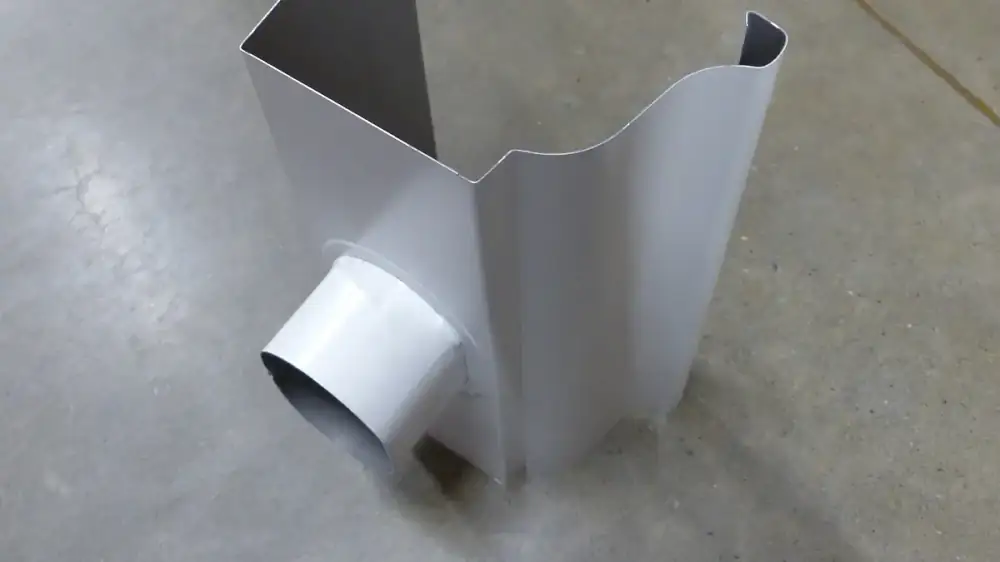
Sizing gutters is about matching capacity to how much water your roof sheds, which depends on roof area, roof pitch, and local rainfall. Bigger and steeper roofs, and regions with intense rain, call for larger gutters, more downspouts, or both. You can estimate run lengths and watch how the system performs in rain from the ground, but measuring the roof and confirming gutter dimensions at height is best left to a professional.
Start with a caution that saves a lot of wasted effort: most of the overflow blamed on undersized gutters is actually a clog. Before you conclude your gutters are too small, confirm they are clean, because a blocked trough overflows at any size. Once that is ruled out, though, a real question remains — some homes genuinely shed more water than their gutters can carry, and no amount of cleaning fixes that. Getting the size right is less about precise arithmetic than about recognizing which conditions demand more capacity.
Sizing is a system question, not a single number
When people say "gutter size," two separate things are actually in play. One is the width and profile of the trough — how much water it can hold and move at any moment. The other is the downspouts — how quickly that water gets emptied out the bottom. These are not independent. A generous trough fed by too few or too-small downspouts still backs up, and an oversized downspout does nothing for a trough that is already spilling along its length.
So think of it as a balance among three quantities: how much water arrives at the gutter, how much the trough can hold and carry, and how fast the downspouts can drain it. A weakness in any one of the three shows up as overflow.
What decides how much water arrives
You never have to calculate this precisely, but it pays to know what raises the load on a given run.
The roof area feeding that run is the biggest lever — a long gutter under a broad roof plane simply collects far more than a short one under a small plane. Roof pitch matters more than people expect: a steep roof gathers and throws more water than its flat footprint would suggest, because driving rain strikes more of the sloped surface, so two roofs with identical footprints can shed very different volumes. Local rainfall is about peaks, not averages — a region that gets short, violent downpours stresses a gutter harder than one with the same annual total delivered as gentle drizzle. And roof valleys, where two planes meet and funnel their runoff to a single point, concentrate water and make that run a classic overflow spot.
A rough guide to sizing up
Use this to judge whether your situation leans toward standard capacity or toward more.
| Your situation | What it suggests |
|---|---|
| Small, low-pitch roof, gentle rainfall | Standard capacity is usually fine |
| Large roof area feeding one run | Consider a larger gutter or extra downspout |
| Steep roof | Higher effective water load; lean toward more capacity |
| Intense, heavy-downpour climate | Size up gutters, downspouts, or both |
| Run collects from a roof valley | Concentrated load; extra downspout often helps |
| Long single runs | Additional downspout shortens the distance water must travel |
The most common real-world decision is a step up in width, and our comparison of five-inch vs. six-inch gutters walks through what that extra inch actually buys. The strongest candidates for it are homes that stack several factors at once — a large, steep roof in a heavy-rain climate, or a single run draining a valley.
The downspout is where most systems really choke
If a gutter is going to fail, the outlet is often where it starts, so downspouts deserve as much attention as the trough. You have two levers when a run cannot keep up: move to a larger gutter profile for more carrying capacity, or add a downspout so the water has an extra exit before the trough overflows. Frequently the best answer uses both. Adding an outlet to a long run — or simply making sure the water it discharges is carried well clear of the house — can do as much for real-world performance as a wider trough. Once the water reaches the ground, keeping it moving away from the foundation is its own task, which is where downspout extensions and a thought-out discharge path earn their keep. For the full path from roof to ground, see how a downspout drainage system works.
What you can judge from the ground, and what you can't
Plenty of useful, low-risk assessment happens with both feet on the grass. You can pace off the length of each run, count the downspouts, note where valleys dump their water, and — most valuable of all — watch how the whole system behaves during an actual downpour. That behavior is more informative than any tape measure: where it overflows first, which outlet backs up, whether the spill is along a length or at a single point. Trained on those details, you will often diagnose a capacity problem without ever leaving the ground. Erosion or splashback below one particular run, or water backing up at an outlet rather than draining, both point toward a size or downspout constraint rather than random debris.
What you generally cannot do safely is measure the roof itself or confirm actual gutter dimensions, since that means working at height. Worth noting: the trough material does not change the sizing logic, but light, common materials like aluminum come in more than one profile, so stepping up a size is usually a genuine option rather than a special order.
Getting the diagnosis right
Sizing is one of those areas where a small amount of professional input goes a long way, precisely because the same symptom can have very different roots. Overflow that persists after you have confirmed the gutters are clear, a decision between a wider gutter and an added downspout, or any assessment that needs the roof measured on a steep or multi-story roofline — these are the moments to bring in someone who can work up there safely and account for your roof area, pitch, and local rainfall intensity together. Start with what you can observe from the ground, and reserve the ladder work and the final call for a pro. For how sizing sits within the larger picture, see our gutters overview.
Questions homeowners ask
How do I know if my gutters are big enough?
The clearest test is behavior in heavy rain. If clean, unclogged gutters still overflow during a downpour, they may be undersized for your roof or served by too few downspouts. Large roof areas, steep pitches, and regions with intense rainfall all push toward bigger gutters or more downspouts. If overflow only happens when the trough is clogged, the issue is cleaning, not size.
What roof measurements matter for sizing gutters?
At a high level, the drainage area feeding each gutter run matters most: the footprint of roof that sheds into it, adjusted for how steep the roof is and how exposed it is to driving rain. A steeper roof effectively catches and throws more water than its flat footprint suggests. You do not need to compute this precisely yourself; the point is that bigger, steeper roofs need more capacity.
When should I size up to a larger gutter?
Consider sizing up when a run drains a large roof area, when the roof is steep, when you live somewhere with heavy or intense rainfall, or when a single run collects water from valleys where two roof planes meet. Homes that combine several of these factors are the strongest candidates. Adding a downspout can be an alternative or a complement to a larger trough.
Do downspouts need to be sized too?
Yes. A correctly sized gutter still overflows if the downspouts cannot carry the water away fast enough. Both the size and the number of downspouts matter, and long runs or high-volume roofs often benefit from an additional downspout. The gutter and downspouts work as a system, so sizing one without the other leaves you with a bottleneck.
Can I measure my gutters from the ground?
You can estimate run lengths and count downspouts from the ground, and you can watch how the system performs in rain, which is often the most useful information. Measuring the roof itself and confirming actual gutter dimensions usually means working at height, which is better left to a professional. Start with ground-level observation and leave rooftop measuring to someone who can do it safely.
Does adding a downspout help more than a bigger gutter?
It depends on where the bottleneck is. If the trough overflows along its length, a larger gutter adds carrying capacity. If water reaches the outlet but backs up there, an additional downspout gives it somewhere to go. Often the best answer combines both, and a professional can help identify which constraint your system is hitting.
More from this section

How Trees Affect Gutter Maintenance
Leaves, pine needles, seed pods and shade each create a different gutter problem. Here's how tree cover reshapes your maintenance schedule.

Why Water Runs Behind Gutters
A missing drip edge, a gutter hung too low, or an overflowing clog — these three causes explain most water that ends up behind the gutter.
Signs Gutters Need Repair Instead of Cleaning
Sagging runs, leaking seams, loose hangers and standing water are repair problems, not cleaning problems. Here's how to tell them apart.