How Your Region Changes Gutter Care
The advice to "clean your gutters twice a year" assumes a climate that doesn't exist everywhere. What your gutters actually need depends on where the house stands.

There's no national gutter schedule, because the two things that stress a gutter — what falls into it and what the weather does to the water inside it — change completely by region. Snow country fights weight and freeze-thaw; the Pacific Northwest fights sustained moisture and moss; the arid Southwest fights sudden, concentrated runoff; the storm-prone Southeast fights capacity and wind-blown debris at once. The care that fits your house follows its climate, not a generic rule.
"Clean your gutters twice a year" is the kind of advice that's easy to give and impossible to make universally right. Twice a year is roughly correct for a temperate lot with a couple of deciduous trees and ordinary rainfall. It's far too little for a house under dripping conifers in a wet coastal climate, oddly timed for a snow belt where the calendar bends around the first hard freeze, and beside the point in a desert where the real threat isn't debris at all.
Gutters respond to their environment. Two forces do most of the shaping: the debris load — what your trees, roof and wind deliver into the trough — and the water behavior — whether that water sits, freezes, arrives in a deluge, or barely comes at all. Sort your region by those two forces and the right care almost writes itself.
Snow country: weight, ice, and timing
In the northern tier and the mountain West, the defining stress isn't leaves. It's what happens to water when it freezes.
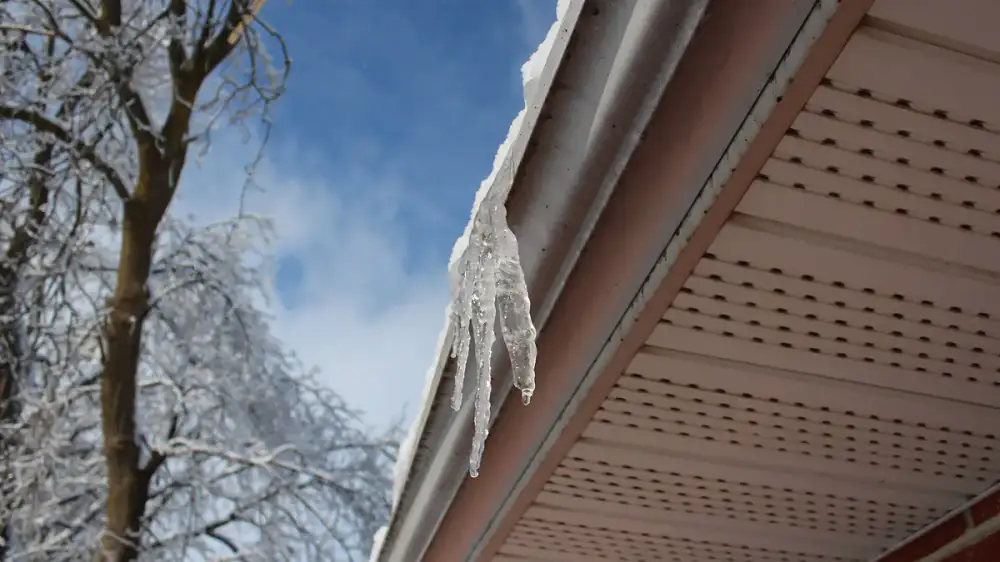
A gutter that goes into winter with debris in it holds standing water, and standing water in a freeze expands. That expansion works at the seams, loosens fasteners, and can deform the trough itself over a season of freeze-thaw cycles. Heavy wet snow and ice add sheer weight, straining hangers and the fascia they're anchored to. The critical move here is timing: the most important cleaning of the year is the one done after the last leaves fall but before the first hard freeze, so the system enters winter empty and able to drain any thaw.
Ice dams deserve a clear-eyed mention, because gutters get blamed for them unfairly. An ice dam forms when heat escaping through the roof melts snow that refreezes at the cold eave — it's fundamentally a roof insulation and ventilation issue, not something gutters cause or cure. A clean gutter won't prevent a dam, but a clogged one gives meltwater nowhere to go, which makes the situation worse. Homeowners weighing de-icing measures should understand that distinction before spending on a fix aimed at the wrong problem.
The Pacific Northwest: it's the moisture, not the downpour
The wet Pacific coast doesn't usually get violent rain. It gets persistent rain — long, steady, gray stretches where the ground never fully dries and neither does anything on the roof.
That sustained moisture changes the debris itself. Conifer needles, which don't have a single dramatic drop like deciduous leaves, shed steadily all year and thread through mesh guards in a way broad leaves don't. Everything stays damp, so debris in the trough decomposes into a heavy, water-holding sludge rather than drying into something you can sweep out. And the region's signature organism, moss, colonizes damp roofs and gutters, forming mats that hold water against the metal and shed clumps that clog outlets.
The care that fits is frequency and vigilance rather than force. Gutters here rarely get a real rest, so the interval between cleanings runs shorter than the national default, and needle-heavy lots may need attention several times a year. Because the water is always present, a small pitch problem or partial clog that a drier climate would tolerate becomes a persistent overflow behind the gutter — and persistent wetting is the fast track to fascia rot in a climate that never gives the wood a chance to dry.
The arid Southwest: don't mistake dry for safe
It's tempting to assume that a region with little rain barely needs gutters. That assumption gets houses in trouble, because the desert delivers its water in a form gutters are very much needed for.
Arid-Southwest rainfall tends to arrive in short, intense monsoon bursts, and it lands on ground that's baked hard and doesn't absorb quickly. A lot of water in a little time, running off a surface that can't soak it up, is a recipe for concentrated erosion and runoff pooling right where you don't want it. Meanwhile the debris load isn't leaves — it's dust, fine grit, and the granules your roof sheds under harsh sun. That fine material doesn't look like much, but it settles into the low spots and outlets and hardens into a cement-like layer that's stubborn to clear.
So the desert profile is low-frequency, high-consequence. You may clean less often than a wooded climate demands, but the drainage job is real: the point is to catch those sudden downpours and move the water away from a foundation sitting in soil that swells and cracks with the rare deep soaking. Getting the runoff clear of the house — the concern behind water pooling near the foundation — matters as much here as anywhere, arguably more, because dry expansive soils react hard to sudden water.
The storm-prone Southeast: capacity and wind, together
Along the Gulf and South Atlantic, the challenge is intensity stacked on top of debris, often in the same afternoon.
Heavy rainfall tests a gutter's capacity directly — the trough and downspouts have to move a lot of water fast, and undersized or partially blocked systems overflow immediately. At the same time, the high winds that come with these storms strip trees and load gutters with debris in a matter of hours. A system that was clear yesterday can be packed and overflowing during today's storm, which means the routine schedule isn't enough on its own. The after-storm check becomes a core habit, not an optional one.
This is the region where sizing and drainage design earn their keep. Adequate downspout capacity and a discharge path that carries water well away from the house — the fundamentals of how a downspout drainage system works — do the heavy lifting when the sky opens up. Combine that with a look after every major storm, and the system stands a chance against weather designed to overwhelm it.
Heavy-tree areas: the variable that crosses every climate
One factor cuts across all of these regions and can override the regional pattern entirely: a lot buried in trees. A house under mature oaks or maples in temperate country can generate a heavier debris load than a bare lot in the rainy Northwest, because the sheer volume of leaves, seed pods and twigs overwhelms the trough on its own schedule.
Tree cover changes the math regardless of where you live. It shortens the interval, makes guards more tempting but no less in need of maintenance, and turns the after-storm check into a leaf-drop-season necessity. The interaction between canopy and gutter care is involved enough to warrant its own treatment in how trees affect gutter maintenance — the short version is that trees can make a mild climate behave like a demanding one.
Building a routine that fits where you live
The practical takeaway isn't a new set of rules to memorize. It's a way of reading your own situation. Ask what lands in your gutters and when — needles year-round, leaves in one autumn burst, dust and grit, storm debris on no schedule at all. Then ask what your climate does to the water inside them — freezes it, keeps it sitting, dumps it all at once, or barely provides it. Those two answers place you, and they tell you whether you're a once-a-year house or a several-times-a-season house, and which moment on the calendar is the one you can't miss.
A generic schedule is a starting guess. The right cleaning frequency for your house is the one calibrated to your region, your trees, and the way your gutters behave when the weather that defines your part of the country actually shows up.
Questions homeowners ask
Does climate really change how often I should clean gutters?
Considerably. A home in the rainy Pacific Northwest with mossy conifers has a completely different debris and moisture load than a house in the arid Southwest that mostly deals with dust and grit. Climate drives what lands in your gutters, how heavy it gets, and how urgently a clog turns into a problem — so the right interval follows your region, not a national rule of thumb.
Are gutters even necessary in a dry climate?
Often yes, and sometimes more than people expect. Arid regions get less rain overall but frequently in short, intense bursts on ground that doesn't absorb quickly. Concentrated runoff hitting dry, hard soil at the foundation can do real damage. The debris load is lower, but the drainage job — getting water away from the house fast — still matters.
What's the biggest gutter concern in snow country?
The combination of weight and freeze-thaw. Wet snow and ice are heavy, and a gutter clogged going into winter holds water that freezes, expands and pries at seams and fasteners. Ice dams at the roof edge are a related roof-and-insulation issue that gutters can't cure, though a clear gutter is part of managing the meltwater once it forms.
Why do storm-prone regions need special attention?
Intense rainfall tests capacity and drainage all at once, and high winds load gutters with debris fast — a single storm can fill a trough that was clean the day before. In these regions the after-storm check matters as much as the routine schedule, because the worst clogs and the heaviest water often arrive together.
I moved to a new climate — should I change my gutter routine?
Almost certainly. A schedule that worked on a bare lot in a dry state may be badly wrong under conifers in a wet one, or in a snow belt where timing before the first freeze is everything. Treat a move as a reset: watch what lands in the gutters through a full year and how they behave in the region's characteristic weather, then build the routine around that.
More from this section

How Trees Affect Gutter Maintenance
Leaves, pine needles, seed pods and shade each create a different gutter problem. Here's how tree cover reshapes your maintenance schedule.

Why Water Runs Behind Gutters
A missing drip edge, a gutter hung too low, or an overflowing clog — these three causes explain most water that ends up behind the gutter.
Signs Gutters Need Repair Instead of Cleaning
Sagging runs, leaking seams, loose hangers and standing water are repair problems, not cleaning problems. Here's how to tell them apart.