Standing Water in Gutters and Why Pitch Matters
Gutters aren't level — they're tilted just enough to keep water moving toward the downspout. When water sits still in the trough, that slope has failed somewhere. Here's why it matters and how to find the cause.
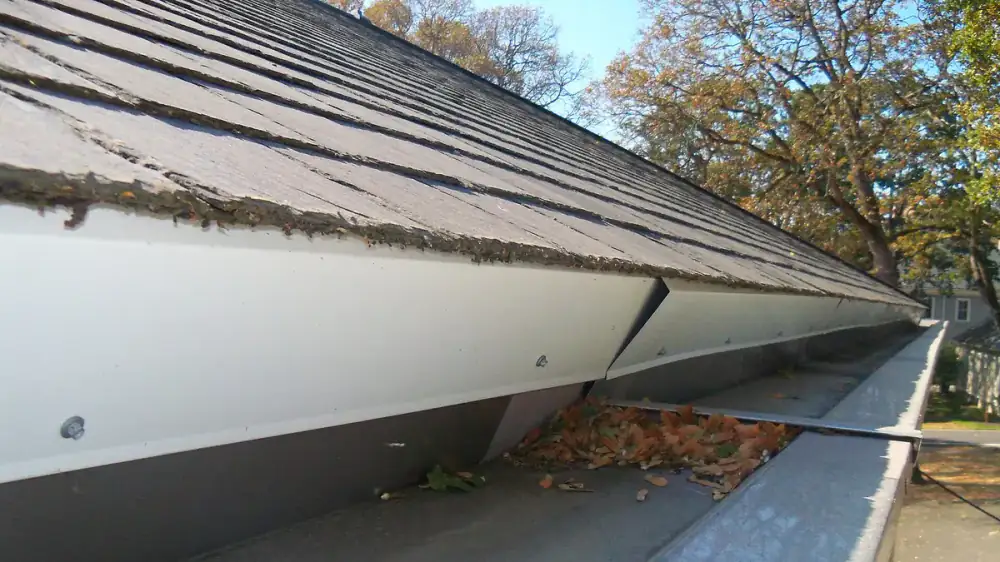
Gutters are hung with a slight tilt toward the downspout so water never stops moving. When it stands still in the trough, that tilt has failed somewhere — nearly always from wrong pitch, a sagging run, a local low spot, or a blocked downspout. It matters because a puddle that lingers adds weight, breeds mosquitoes, feeds corrosion, and freezes in winter. Pin down which of the four is at work, and the fix comes with it.
Here is the fact that catches most homeowners off guard: a gutter is not supposed to be level. It is hung on a deliberate slant, subtle enough that you would never notice it from the yard, so that gravity keeps water sliding along the trough and out the downspout. That gentle, steady tilt is called pitch, and it is the one feature that separates a working gutter from a long, narrow pan that merely holds water until it evaporates or overflows. So when you spot water sitting motionless in a gutter, you are not looking at a cosmetic quirk. You are looking at proof that the pitch has stopped doing its job somewhere along the line.
Gutters are built to lean
A properly pitched gutter carries water in exactly one direction — toward the downspout and off the house. There is no single correct number that fits every home, because the right slope depends on the length of the run and how it was hung. What you are really after is the outcome, not a measurement: after a good rain, the water should drain away and leave the trough close to empty. Get the tilt wrong in any direction and the draining stops. Too little slope, a slope running backward, or a dip partway along the run all create a place where water gathers rather than flows. The puddle you can see is simply the visible receipt for a pitch that has quietly failed.
When the slope gives out
Standing water almost always traces to one of four causes, and telling them apart is most of the battle.
Pitch that was never right, or drifted
Sometimes the slope was off from the start, and sometimes it shifted over years as the house settled and fasteners crept. Either way, a run that is too flat — or leaning slightly the wrong way — leaves water sitting instead of leaving. The signature is pooling that shows up in the same section, storm after storm.
A sagging run
Even a gutter hung with perfect pitch will grow a low spot if it sags. Weight from clogged debris and standing water, or hangers that have let go, drags a section down, and that dip becomes a reservoir. Sag and standing water are so tightly linked they are often one problem viewed from two directions — more in why gutters sag and loose gutter hangers.
A localized low spot
A dip can form without any obvious overall sag — a single hanger that slipped, a section hung a touch too low, or damage from a fallen branch or a load of ice. Water finds that lowest point and settles in. From the ground it reads as a small puddle sitting in an otherwise dry, clean trough.
A blocked downspout
If water cannot get out, it backs up and stands, even in a well-pitched gutter that looks spotless. The blockage often hides at the outlet where the trough necks into the downspout, or lower down inside the pipe where you cannot see it. It is a common cause and an easily missed one; see why downspouts keep clogging.
The slow damage of a lingering puddle
Standing water looks harmless — it is just a little water, after all — which is exactly why it gets shrugged off. But left in place it drives several kinds of slow damage at once. It is an ideal mosquito nursery, sitting at roof level right against the house. It is constant dead load on the hangers and fascia, stressing the hardware and deepening any existing sag, which then holds still more water in a loop that feeds itself. It keeps metal wet, and metal that stays wet corrodes faster than metal that drains and dries, so persistent pooling shortens the life of the trough. And in cold climates it freezes and expands, distorting the gutter, loosening fasteners, and contributing to ice damming — the subject of how snow and ice damage gutters. None of these arrive overnight. Together they turn a small drainage nuisance into a maintenance problem that compounds, which is why a puddle that lingers days after rain, or shows up in dry weather, sits firmly on the list of signs your gutters need repair.
Reading the run from the yard
You can learn most of what you need without touching a ladder, just by observing carefully at ground level. A day or two after a solid rain, look for a section still cradling a visible puddle while the rest of the run has drained — that is your low point or your blockage. During a storm, watch for water backing up and topping the edge at one spot with little coming out below, which points toward a blocked outlet. Sight down the length of the gutter from one end, too: a healthy run reads as a straight line with a faint, steady tilt, so a visible dip or wave marks a sag or low spot. And check what the downspout is doing — a strong stream at the bottom means it is clear, while a trickle or nothing while water stands above tells you the blockage sits at or below the outlet. Between those four observations you can usually name the culprit before anyone lays a hand on the gutter.
Restoring the slope
The remedy follows straight from the cause. A blocked downspout or outlet just needs clearing and a flush to confirm flow, and it is worth ruling out first because it is the easiest to fix. A sag or low spot calls for the section to be re-hung so the slope is restored, often with added or replaced hangers. Wrong pitch means the run has to be re-set to tilt steadily toward the downspout — a repair, not a cleaning. And if the fascia behind the gutter has gone soft, that wood has to be repaired before re-hanging, or the new slope simply will not hold; see what causes fascia rot. Whatever the work, a hose test afterward is the proof: the trough should drain to the downspout and leave almost nothing behind.
A few shortcuts do more harm than good and are worth naming so you can skip them. Assuming clean means draining is the first — a spotless gutter still pools if the pitch is wrong or the outlet is blocked. Drilling weep holes to let a puddle escape is another; it treats the symptom, invites corrosion, and leaves the real slope problem untouched. Pushing a sag back up without resetting the pitch only relocates the puddle. And forgetting the downspout ignores the single most common and most overlooked cause of all. Because re-pitching is genuinely height work, correcting slope from an unsteady ladder is a poor trade, and a sagging run, a clearly wrong pitch, soft fascia, or any repair beyond safe reach from the ground is the point to hand the job to someone equipped for it.
Standing water is easy to dismiss, but it is really a sign that the one thing a gutter must do — keep water moving — has stopped. Fixing the pitch restores that, and heads off the slow chain of weight, corrosion, and ice that a still puddle quietly sets in motion.
Questions people also ask
Is a little standing water in gutters normal?
A small film that dries within a day or so after rain is common and rarely a concern. What matters is standing water that lingers — a visible puddle that's still there days later, or in dry weather. Persistent pooling means water isn't reaching the downspout, and that points to a pitch, sag, or blockage problem worth addressing.
How much slope should a gutter have?
Gutters need only a slight, steady slope toward the downspout — just enough that water always moves in one direction rather than sitting still. The exact amount depends on the run and the installation, which is why it's best judged by a professional. The practical test is simple: after rain, water should drain to the downspout and leave the trough, not pool in the middle.
Why does water sit in my gutter even though it's clean?
A clean gutter can still hold standing water if the pitch is wrong, if a run has sagged into a low spot, or if the downspout is blocked lower down where you can't see it. Cleaning removes debris but doesn't correct slope or a failed hanger, so pooling in a clean gutter usually points to one of those causes.
Can standing water damage my gutters?
Over time, yes. Standing water adds constant weight that stresses hangers and can deepen a sag, it accelerates corrosion in metal gutters, it becomes a breeding site for mosquitoes, and in cold weather it freezes and expands. None of these are sudden, but together they shorten the life of the system and tend to make problems compound.
Does standing water mean my gutters need replacing?
Not usually. Most standing-water problems are fixed by correcting the pitch, re-hanging a sagging run, or clearing a blocked downspout — repairs, not replacement. Replacement enters the picture only when the gutters are also corroded, widely damaged, or beyond re-hanging. Standing water alone is typically a repair-level issue.
When should I call a professional about standing water?
Call a professional when cleaning and clearing the downspout don't resolve the pooling, when a run sags or the pitch looks wrong, or when correcting the slope requires ladder or roof access you can't manage safely from the ground.
Related reading

How Trees Affect Gutter Maintenance
Leaves, pine needles, seed pods and shade each create a different gutter problem. Here's how tree cover reshapes your maintenance schedule.
Why Water Runs Behind Gutters
A missing drip edge, a gutter hung too low, or an overflowing clog — these three causes explain most water that ends up behind the gutter.
Signs Gutters Need Repair Instead of Cleaning
Sagging runs, leaking seams, loose hangers and standing water are repair problems, not cleaning problems. Here's how to tell them apart.