Gutters Overflow Only in Heavy Rain
Gutters that stay dry in a drizzle but sheet water over the edge in a downpour are telling you something specific about capacity, flow, or a hidden restriction.

Gutters overflow only in heavy rain because peak flow briefly exceeds what the system can carry. In a drizzle the water fits; in a downpour it doesn't. The bottleneck is usually an undersized or clogged downspout, too little slope, or gutters too small for the roof — or water overshooting the edge off a steep roof. Clean first, then look for the flow restriction, and leave sizing and roof-edge fixes to a professional.
A gutter that overflows in every rain has an obvious problem. A gutter that behaves perfectly for months and then spills only during the hardest storms is more puzzling — nothing looks broken, and most of the time it clearly works. But that on-again, off-again pattern is a clue in itself, and a precise one. It means the system can keep up with ordinary flow and falls behind only at the peak. Somewhere between your roof and the ground is a spot where water arrives faster than it can leave, and it stays invisible right up until the rain gets serious enough to expose it. Finding that spot is the entire job.
Think of it as a bottleneck, not a leak
The mental shift that makes this problem solvable is to stop thinking of overflow as damage and start thinking of it as a rate problem. Your gutters don't need to hold all the rain that falls; they need to move it along at least as fast as it's arriving. In light rain, water trickles through every restriction without trouble. In a downpour, the volume per minute climbs sharply, and the narrowest point in the whole path — whatever it is — becomes the ceiling. Water stacks up behind that ceiling and spills over the nearest low edge. The bottleneck was always there; the storm just filled the system fast enough to reveal it. Everything below is a catalog of what that bottleneck tends to be, roughly in order of how often it's the answer.
A partial clog
Debris doesn't have to block a gutter completely to cause trouble. A layer of leaves and grit that light rain trickles past will choke a downpour, slowing flow just enough that the trough fills and spills. Partial clogs near an outlet are the worst offenders, because everything funnels through that one point on its way out.
An undersized or restricted downspout
The downspout is the drain for an entire run, and it's a common ceiling. If it's narrow, partly blocked, or there's only one serving a long stretch of gutter, it caps how fast the whole run can empty. Water backs up behind it and overflows at the nearest low spot — very often the corner right above the outlet, which is why overflow that concentrates in one place points straight at the downspout below it.
Too little slope
Gutters need a slight, consistent fall toward the downspout to keep water moving. A section that's close to level, or one that has sagged over the years, lets water pool and creep instead of run, and a heavy rain overwhelms that slow stretch before any other.
Gutters too small for the roof
Sometimes nothing is blocked or misaligned — there's simply not enough gutter. A large or steep roof can shed an enormous volume in a short burst, and narrow troughs or too few downspouts may handle everyday rain while lacking the capacity for a genuine downpour, no matter how clean and well-pitched they are.
Water overshooting the edge
This one masquerades as overflow but is something else entirely. On steep roofs, runoff can build enough speed to leap the front lip of the gutter rather than drop into it — so the water never enters the trough at all. It tends to show up along specific roof planes or below valleys where the flow concentrates, and no amount of cleaning the gutter will change it, because the gutter isn't the problem.
Reading the storm from the ground
The good news is that the diagnosis needs no ladder — the best time to gather evidence is during and just after a downpour, standing safely below.
- Watch where it spills. Overflow at one consistent point usually means a restriction right there; overflow along a whole run points to slope or raw capacity.
- Look at the downspouts. Water gushing steadily from the bottom means flow is getting through. A downspout that only trickles while the gutter above it spills is telling you something below is blocked or undersized.
- Check for standing water afterward. A gutter line that visibly dips or holds water after the rain stops betrays a sag or lost slope.
- Trace the pattern below the overflow. Splashback, eroded mulch, or stained siding under a fixed point show you where the water lands again and again.
- Read the roof above. A long or steep plane feeding one short section of gutter is a capacity mismatch worth flagging even before anything else.
The aim is to pin down where and when the water escapes, because that combination tells you whether you're chasing a clog, a slope issue, or true undersizing. Our overview of overflowing gutters and their causes walks through how these factors interact when more than one is involved.
Start simple, then escalate
Work from the cheapest, most likely fix toward the structural ones. Clear the gutters and outlets first: removing debris from the trough and confirming each downspout outlet is open restores flow, and for a lot of homes a partial clog was the entire story. A low, single-story section you can reach from stable footing is reasonable ground-adjacent work; anything higher is a professional's job. Then confirm the downspouts are actually flowing during or right after rain — a blocked underground drain or a crushed elbow can back up a clean system from below. While you diagnose, keep water moving away from the wall with downspout extensions and splash blocks; that won't stop the overflow, but it limits what the misplaced water can damage in the meantime.
If overflow continues after a thorough cleaning, you've likely moved past anything a homeowner fixes with a bucket. Insufficient slope, undersized gutters, too few downspouts, and roof overshoot are structural, and the honest response is to note where and how the overflow happens and hand that detail to a professional. Two temptations to resist along the way: don't assume it's always clogs, because repeated cleaning won't cure a capacity problem, and don't expect larger guards or screens to help — they can manage debris but do nothing to increase how much water a gutter carries, as gutter guards that overflow in heavy rain explains. And don't dismiss storm-only overflow as harmless; water landing in the same spot every downpour still stains walls, soaks fascia, and pools by the foundation.
When it's genuinely a professional's fix
Bring in a pro when overflow persists after the gutters and downspouts are clean, when the trail leads to slope, gutter size, or the number of downspouts, or when water is overshooting a steep roof edge. Those fixes mean re-pitching a run, adding capacity, or reworking the edge itself — work that needs proper access and know-how, and that involves real height and fall risk when it's up high. It's also worth an expert eye if overflow has already produced damp fascia, dark stains on the soffits, or water pooling at the foundation, since those mean the runoff has been going where it shouldn't for a while. To compare your situation with other drainage complaints, browse the full list of common exterior problems.
Questions homeowners ask
Why do my gutters only overflow in heavy rain and not light rain?
Because light rain produces a volume of water your system can still carry, while a downpour delivers more than the gutter or downspout can move in the same amount of time. The bottleneck is always there, but it only reveals itself when peak flow exceeds capacity. Common bottlenecks include an undersized downspout, a partial clog, too little slope, or a section of gutter that simply can't hold the volume a hard rain delivers.
Does overflow in heavy rain always mean my gutters are clogged?
Not always. A clog is one common cause, but overflow that appears only in downpours can also come from undersized gutters or downspouts, too little slope toward the outlet, or water overshooting the gutter as it pours off a steep or large roof. Clearing debris is the right first step, but if overflow continues after cleaning, the issue is more likely capacity or flow than a blockage.
Can gutters be too small for the roof?
Yes. A large or steep roof sheds a surprising amount of water very quickly during a downpour, and narrow gutters or a single small downspout can be overwhelmed even when they're perfectly clean. If your gutters overflow in heavy rain despite being clear and correctly sloped, undersized components or too few downspouts are a likely explanation, and that's worth a professional assessment.
Why does water shoot over the gutter instead of into it?
On steep roofs or during intense rain, water can gain enough speed that it overshoots the gutter's front edge rather than dropping into the trough. This often looks like overflow but is really the water never entering the gutter in the first place. It tends to happen along specific stretches, especially below long roof planes or valleys where runoff concentrates.
Could one clogged downspout cause overflow everywhere?
A single blocked or undersized downspout can back up an entire run of gutter, because water that can't drain fast enough fills the trough and spills over the nearest low point. If overflow concentrates near one corner or above one downspout, that outlet is the first thing to check. Water pooling around a downspout during rain is a strong clue.
Is occasional heavy-rain overflow something I can ignore?
It's easy to dismiss because it only happens during storms, but repeated overflow sends water where the system was designed to keep it away from — against the fascia, down the siding, and into the ground beside the foundation. Even if it looks minor, water landing in the same spots storm after storm can lead to staining, damp walls, and drainage problems over time.

Why Green Growth Keeps Returning on Siding
Algae and mold return because cleaning removes the growth but not the shade and moisture that feed it. Fixing those conditions is what makes it stop.
Moss Growing on the Roof: What to Do
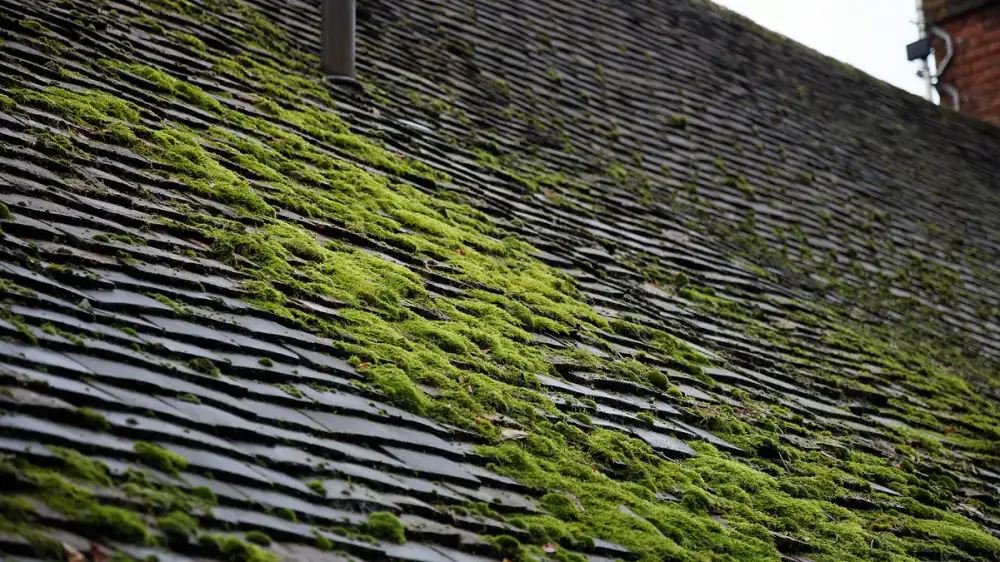
Moss takes hold on shaded, damp roof sections and holds moisture against the shingles — but removing it from the roof is risky work for a professional.

Efflorescence: The White Residue on Brick
The white powder on brick is efflorescence — mineral salts drawn to the surface by moisture moving through the masonry and left behind as water evaporates.