Stains That Appear Only After It Rains
A stain that darkens with every rain and fades as things dry is doing something a permanent stain can't — it's showing you an active water path in real time.

A stain that appears only after rain is an active water path revealing itself — it darkens because water is reaching that spot during the storm and fades as the surface dries. That intermittent behavior is the signature of a leak, not old residue. The source is usually gutter overflow above, a failed seal or flashing, or water running behind trim. Chase it live during a storm from the ground, fix the water path, and only then bother cleaning the mark.
Most marks on a wall are fossils. They record something that already happened and then sit there, dry and unchanging, whatever the sky is doing. A stain that appears only after rain belongs to a different category entirely. It shows up when the clouds open, deepens while the storm runs, and quietly bleeds away over the following day, ready to perform the whole cycle again next time. People tend to find that behavior spooky. It's actually the most cooperative thing a stain can do — because instead of hiding its origin, it re-enacts it for you on a schedule you can predict.
A stain with a clock in it
Ask what it takes for a mark to keep this rhythm. Dry residue — mineral buildup, old growth, weathering — doesn't care about the weather; it looks the same in a drought as it does in a deluge. For a stain to darken and then lighten, it has to be wet, and it has to dry out. The color is mostly the dampness itself, along with whatever the water dragged onto the surface, and the fade is nothing more than that moisture evaporating once the supply stops.
Which means the water only visits during and just after the rain. It reaches that patch of wall while it's storming, then drains or dries away when the sky clears. You are, in effect, watching a small, intermittent plumbing system switch itself on and off — and the on switch is the rain. That timing is not a nuisance. It's the appointment the leak keeps with you, and it tells you precisely when to be standing there.
Treat it as a live leak, not a stain to scrub
Because the mark tracks water in real time, you can be almost certain you're looking at an active leak: water arriving somewhere it shouldn't for as long as the rain lasts. Naming it that way changes what you do next. A permanent stain invites forensics — squinting at a dry mark weeks later, guessing at a story. A rain-only stain invites observation. The difference is enormous, because a dry stain keeps its secret and a wet one hands it over, provided someone bothers to look while the water is still moving.
The routes the water tends to take
The water surfacing at that spot almost always arrived by one of a small set of paths. Recognizing which one narrows the whole search.
| The route | What it usually looks like |
|---|---|
| Overflow from a gutter above | Stain sits below a seam, a downspout, or a known spill point; worst in heavy downpours |
| A failed seal or flashing | Mark starts from one fixed point around a window or door and returns with every rain |
| Water behind trim or a penetration | Stain surfaces some distance from the true entry, having traveled hidden first |
| Intrusion that reaches inside | The same wet-then-fade pattern appears indoors on a ceiling or wall |
The gutter case is the classic. A run that only spills in a real downpour delivers water straight down the wall exactly when it rains and never otherwise — the same dynamic behind gutters that overflow only in heavy rain, where correcting the spill does far more than any cleaning. Failed seals and flashing show a different fingerprint: the stain begins at a specific interrupted point in the wall and re-appears with every rain, the way a bad corner of caulk drives dark drip marks under the windows. And when the water works all the way through, the very same rain-only mark surfaces indoors — the interior relative of water in the basement after heavy rain.
Be outside when it's working
Here is the move that runs against every instinct: don't wait for a dry, pleasant afternoon to investigate. The path is invisible when it's dry. Go out during or right after the storm, stay on the ground, and read what the active leak is willing to show you.
- Find where the stain begins and which way it grows. Water runs down and sideways, so the top of the mark sits closer to the entry than the bottom.
- Look straight up from the top of the stain. A gutter spilling, water sheeting off one point, or a trickle from a joint often gives the source away instantly.
- Match it to the rain. Worse in heavy rain points upward to drainage and capacity; showing up with every rain from one fixed point points to a seal or flashing right there.
- Time the fade. A stain that lightens quickly once the rain stops confirms it's chasing intermittent water rather than settled residue.
- Check for a feature overhead — a window corner, a downspout, a roof valley — that concentrates water at exactly that spot.
You are not opening anything up and you are not climbing. You're simply present while the water is, because that is the only moment it tips its hand.
Why "it goes away on its own" is the trap
It's tempting to shrug a fading stain off as cosmetic — if it disappears by itself, how serious can it be? That logic is backwards. The stain fading does not mean the water left for good; it means the water is intermittent. Every rain, it returns and wets the same materials again. That repeated soaking is what quietly works on whatever sits behind the surface, long before anything looks dramatic from the outside. A mark that keeps coming back is a wall that keeps getting wet, and a wall that keeps getting wet eventually sends the bill. The vanishing act is the disguise, not the all-clear.
Fix the path, then deal with the mark
Once you've traced the route, the repair follows the source rather than the stain. If it's gutter overflow, restoring flow and carrying the water away stops it from ever touching the wall. If it's a failed seal at a spot you can reach from the ground, refreshing it can close the entry — but only if you strip and prep the old material so the new bead actually bonds to clean, dry substrate. If the trail climbs to flashing, a hidden path, or anything at the roof edge or an upper story, that's where it leaves homeowner territory. Chasing a leak from a wobbling ladder in wet weather trades a stain for a fall; height belongs to someone with proper access.
Cleaning is the last step, never the first. Scrub the mark before the water is handled and you'll be back after the next storm, having erased your best diagnostic and left the leak untouched. Treating a visible symptom while the real cause keeps working is exactly why so many exterior repairs don't hold. Bring in a professional when the path leads somewhere you can't safely reach, when you simply can't tell where the water enters, or when the mark now comes with soft, spreading, or musty damage that says the intrusion has been busy for a while.
A stain that appears only after it rains can feel like the house withholding something, but it's the reverse: it's confessing on a timetable. Show up when the water does, follow it back to the source, and repair the route instead of the smudge. For how this sits among the other water stories a house tells, the full list of common exterior problems is worth a wander.
Frequently asked questions
Why do stains show up on my wall only after it rains?
Because the stain is being caused by water that's only present when it rains. A permanent stain is dry residue; a stain that appears with rain and fades as things dry is wet, meaning water is actively reaching that spot during the storm and then evaporating afterward. That coming-and-going behavior is the giveaway that you're looking at an active water path, not old staining — the water is essentially drawing the leak's route for you each time it rains.
Are rain-only stains a sign of a leak?
Almost always, yes. A stain that reliably darkens with rain and lightens as it dries is following water in real time, which means water is getting somewhere it shouldn't during the storm. It might be entering through a failed seal, running behind trim, or overflowing from a gutter above and tracking down. The exact path varies, but the pattern itself — wet with rain, fading when dry — is the signature of an active leak worth tracing.
Why does the stain fade when everything dries out?
Because the discoloration is largely the dampness itself, plus whatever the water carries with it. As the wall dries, the moisture that darkened the surface evaporates and the stain lightens. This is actually useful information: a stain that fully fades is tracking active water, while one that stays put even when dry is either old residue or a spot where growth or mineral deposits have set in. The fading tells you the water is intermittent, not constant.
Can gutters cause stains that only appear after rain?
Frequently. A gutter that overflows only in heavy rain sends water down the wall exactly when it's raining and nowhere the rest of the time, which produces a stain that appears with storms and fades between them. If the stain sits below a gutter seam, a downspout, or a spot that overflows, the drainage above is a leading suspect — and fixing the overflow often does more than any amount of cleaning the stain.
Should I clean the stain or find the source first?
Find the source first, or at least at the same time. Cleaning the stain without addressing the water just means it comes back with the next rain, because you've treated the mark and not the leak. The most useful thing you can do is watch during a storm to trace where the water is coming from, then address that source. Cleaning becomes worthwhile once the water path is fixed and the stain won't simply return.
How do I find where the water is getting in?
Watch during and right after rain — that's when an active path reveals itself. Note where the stain starts and which direction it spreads, look above it for a gutter overflowing or water running down from a joint or penetration, and see whether it worsens in heavy rain (pointing upward to drainage) or appears with every rain from one fixed spot (pointing to a seal or flashing there). Tracing it live, from the ground, is far more revealing than studying a dry stain later.
Related reading

Why Green Growth Keeps Returning on Siding
Algae and mold return because cleaning removes the growth but not the shade and moisture that feed it. Fixing those conditions is what makes it stop.
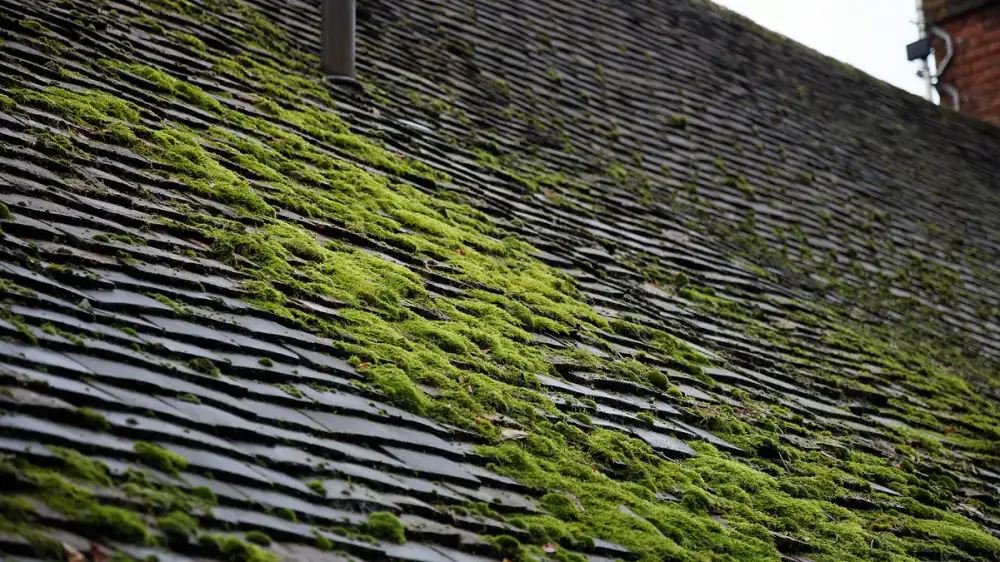
Moss Growing on the Roof: What to Do
Moss takes hold on shaded, damp roof sections and holds moisture against the shingles — but removing it from the roof is risky work for a professional.

Efflorescence: The White Residue on Brick
The white powder on brick is efflorescence — mineral salts drawn to the surface by moisture moving through the masonry and left behind as water evaporates.