The Case for Cleaning Your House Gently
The instinct to blast a dirty house with as much force as possible is almost always the wrong one. Gentler cleaning isn't the timid choice — it's usually the smarter one.

On most of a house — siding, stucco, painted trim, roofs — gentler cleaning is the smarter choice, not the cautious one. Low pressure paired with the right cleaning solution removes algae, mildew and grime as thoroughly as brute force, without cracking panels, stripping finishes or driving water into the wall. Save high pressure for hard, durable surfaces like concrete. The working rule: use the least force that does the job, and let chemistry do the rest.
There's a particular satisfaction to pointing a pressure washer at a dirty wall and watching the grime lift off in a clean stripe. It feels decisive. It feels thorough. And on the majority of a house, it's the wrong instinct dressed up as competence.
The case for cleaning gently isn't a case for timidity. It's an argument about where cleaning power actually comes from, and about the fact that most of what makes a house look dirty is not really dirt at all.
Most exterior grime is alive
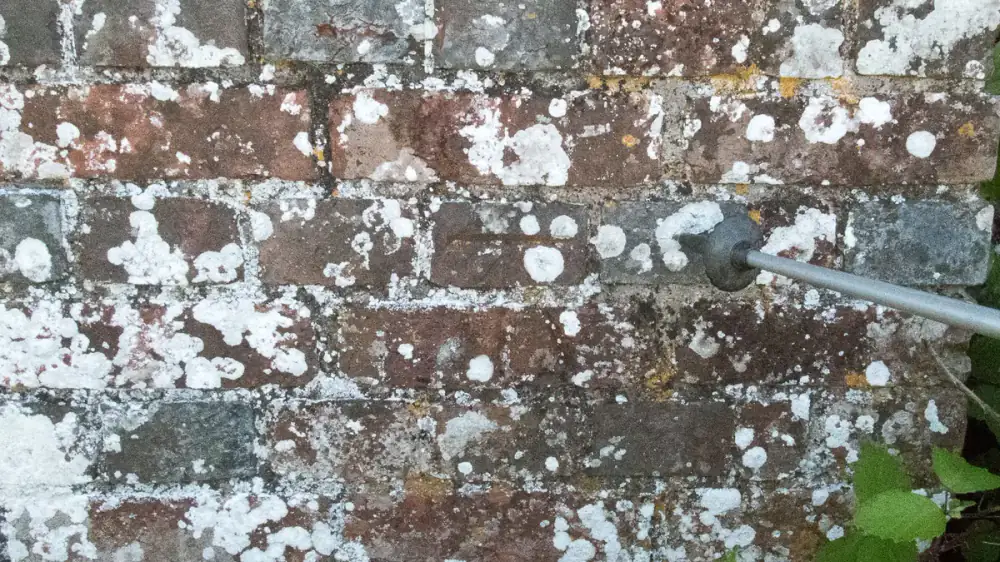
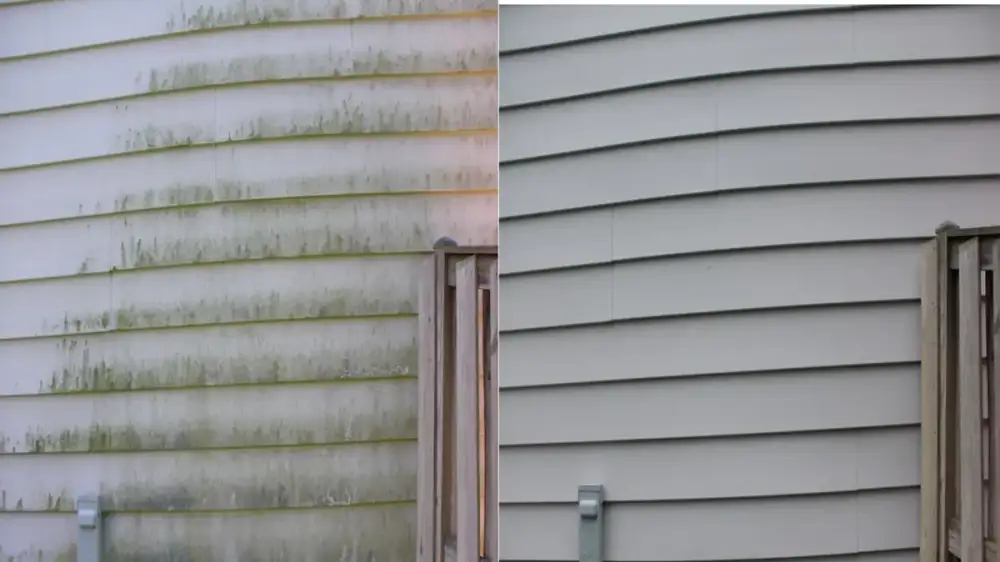
Walk up to the dingy side of a house — the north-facing wall, the shaded corner, the stretch under a tree — and look closely at what's discoloring it. More often than not, it isn't a layer of dust that settled there. It's algae, mildew, lichen or the dark organic staining they leave behind. It's growing.
That single fact reframes the whole problem. You can't blast off something that has roots and expect it to stay gone. Force removes the visible layer and leaves the rest, which is exactly why green growth keeps coming back on siding after someone spends an afternoon pressure washing it. The wall looked clean by dinnertime and looked tired again by the next damp season, because nothing that was actually living got treated.
Cleaning chemistry works the other way around. A cleaning solution breaks the growth down where it sits, so a gentle rinse carries away not just the surface stain but what was producing it. That's the mechanism behind how soft washing works: the pressure is there to apply and rinse, not to demolish. The cleaning power lives in the solution.
Force and cleaning are not the same thing
We tend to conflate two ideas — "getting it clean" and "hitting it hard" — as if they were the same lever. They aren't. On a concrete driveway they happen to line up, because concrete is hard enough that force and cleaning arrive together. On almost everything else, they diverge, and the gap between them is where damage lives.
Consider what high pressure does when it meets a surface that can't absorb it:
- Siding. Aimed upward or into the seams, pressurized water slips behind the panels the wall was designed to shed it from. Now it's against the sheathing, where you can't see it and it doesn't dry. The panel looks clean; the wall is wetter than it's ever been. This is the quiet way pressure washing damages siding — not with a visible crack, but with water where water shouldn't be.
- Painted and aged wood. Force strips the finish it's supposed to be cleaning and raises the grain underneath. You've cleaned the paint off. That's not the assignment.
- Stucco and older mortar. Both are porous and both give up material under a hard stream. You end up etching the surface you meant to freshen.
- Roofs. Asphalt shingles are protected by a layer of granules. High pressure dislodges them, trading a clean roof today for a shorter-lived one. It's rarely worth it, and the height alone is a reason to keep off.
None of these failures make the house cleaner. They just make it damaged and clean at the same time.
Gentle isn't weaker — it's better aimed
The mental model worth adopting is that you're not choosing between "strong" and "weak." You're choosing where to put the effort. Brute force puts all of it into the water. Gentle cleaning puts most of it into the chemistry and the dwell time, and uses just enough water pressure to carry the results away.
That's why the gentle approach often cleans more thoroughly on the surfaces where it belongs. A cleaning solution reaches into the texture of stucco or the grain of wood in a way a stream skating across the surface never does. It doesn't need to overpower the growth; it dissolves the conditions the growth depends on. The comparison between pressure washing and soft washing really comes down to this: one method assumes the answer is more force, the other assumes the answer is the right solution applied patiently.
And patience is the actual cost here. Gentle cleaning asks you to wait — to let the solution work before you rinse. That's the trade. In exchange, you don't gamble the wall.
The damage you don't see is the expensive kind
Part of why the hard-force instinct persists is that its feedback loop is dishonest. The satisfaction is immediate and visible. The damage is delayed and hidden.
A cracked vinyl panel might not reveal itself until it flexes in the next cold snap. Water driven behind siding announces itself weeks later as a musty smell or a soft spot, long after anyone would connect it to the cleaning. A stripped finish looks fine until the wood starts to weather where it's now exposed. By the time the bill arrives, it doesn't look like it came from the cleaning at all.
Gentle cleaning has no equivalent hidden tab. Its worst-case outcome is usually "I needed a second pass" — you underestimated the dwell time and had to reapply. That's a cheap mistake. Compare it to opening up a wall assembly, and the asymmetry is the whole argument.
This is also why some surfaces belong on a do-not-blast list regardless of how patient you are. It's worth knowing which exterior surfaces should not be pressure washed before a wand ever comes out, because "I'll just be careful" is not a plan for a material that fails reliably under force.
Where pressure still earns its place
None of this is an argument that pressure washing is bad. It's an argument for matching the tool to the surface, and for making gentle the default rather than the exception.
High pressure genuinely belongs on hard, non-porous surfaces that shrug it off — concrete driveways, many patios, sound masonry, pavers. Even there, "durable" doesn't mean "immune": hold the stream too close to concrete and you'll leave a stripe etched into it. The point isn't that force is never right. It's that force should be a decision you reach for on purpose, on a surface you've confirmed can take it — not the automatic setting you reach for out of habit.
The same logic scales to the whole house. A material like vinyl siding has a specific tolerance, a specific way it sheds water, and a specific way it fails when you ignore both. Cleaning it gently isn't underachieving. It's respecting how the thing is built.
A default worth keeping
If you take one working rule from all of this, make it this: use the least force that gets the job done. Start gentle. Give the chemistry time. Step up the pressure only on surfaces you've confirmed can take it, and only as far as they actually need.
It's a slower philosophy, and a quieter one. It doesn't produce the dramatic peel-away stripe that makes for a satisfying video. But it cleans the house without gambling the wall behind it — and a year later, when the finish is intact and the growth hasn't rushed back, the gentle version is the one that looks like it worked.
Questions homeowners ask
Isn't more pressure just faster and more thorough?
Faster on hard surfaces like concrete, yes. But on siding, stucco, painted wood and roofs, more pressure mostly buys more risk — cracked panels, stripped finish, water driven behind the wall — without cleaning any better, because the discoloration is often living growth that force spreads rather than removes.
Does gentle cleaning actually get a house clean?
Yes, when the cleaning power comes from the right place. Soft washing lets a cleaning solution break down algae, mildew and grime, then rinses it off at low pressure. The chemistry does the work the force was doing, without the collateral damage, and the result usually lasts longer.
So when is high pressure the right call?
On genuinely hard, non-porous surfaces that can take it — concrete driveways, some masonry, pavers. Even then, distance and technique matter, because a stream held too close can etch concrete. Gentle-first is a default, not an absolute ban on pressure.
Will gentle cleaning keep algae and streaks away longer?
Usually, because it treats the growth rather than knocking off the top layer. Force can leave a wall looking clean while the roots and spores stay behind, so the staining comes back within a season. A cleaning solution addresses what's actually growing.
If gentle is better, why do so many people still use high pressure?
Because it's dramatic and instantly satisfying — the grime visibly peels away. The damage, by contrast, is often delayed and hidden: water behind a panel, a finish that fails a year later. The feedback loop rewards the wrong instinct.
More from this section

Pressure Washing vs Soft Washing
One relies on force, the other on cleaning solution at low pressure. Matching the method to the surface is what protects siding, roofs and trim.
How to Remove Algae from Exterior Walls
That green film is a moisture problem, not just dirt. Here's why gentle cleaning beats blasting, how to protect plants and windows, and how to stop it coming back.
Can Pressure Washing Damage Siding?
The same force that strips dirt can crack panels, peel paint and push water into the wall. Here's how siding gets damaged — and the safer way to clean it.